
Antimicrobial resistance (AMR) has become one of the greatest threats to global public health.
A landmark study published in The Lancet estimated that 1.27 million deaths in 2019 were directly attributable to bacterial antimicrobial resistance (AMR), while nearly 5 million deaths were associated with bacterial AMR. Remarkably, 73% of AMR-attributable deaths were caused by just six bacterial pathogens, underscoring the urgent need for effective surveillance, infection prevention, antimicrobial stewardship, and rapid diagnostics.
Among these pathogens, three Gram-negative bacteria deserve particular attention:
- · Klebsiella pneumoniae (KPN)
- · Acinetobacter baumannii (Aba)
- · Pseudomonas aeruginosa (PA)
These organisms are increasingly resistant to carbapenems—the cornerstone of treatment for many severe Gram-negative infections—and are recognized globally as priority pathogens.
WHO Identifies These Pathogens as Critical or High Priorities
The WHO Bacterial Priority Pathogens List (BPPL) 2024 identifies antimicrobial-resistant bacteria requiring urgent investment in new diagnostics, therapeutics, vaccines, and infection prevention strategies.
Among the Critical /High Priority pathogens are:
- · Carbapenem-resistant Acinetobacter baumannii (CRAB)
- · Carbapenem-resistant Pseudomonas aeruginosa (CRPA)
- · Carbapenem-resistant Enterobacterales (CRE), including Klebsiella pneumoniae (CRKP)
The WHO further emphasizes that tackling these pathogens requires a comprehensive approach combining rapid diagnostics, surveillance, antimicrobial stewardship (AMS), and infection prevention and control (IPC) rather than relying solely on the development of new antibiotics.
International Guidelines Highlight the Importance of Rapid Diagnostics
Combating AMR requires more than effective antibiotics—it depends on timely and accurate diagnosis.
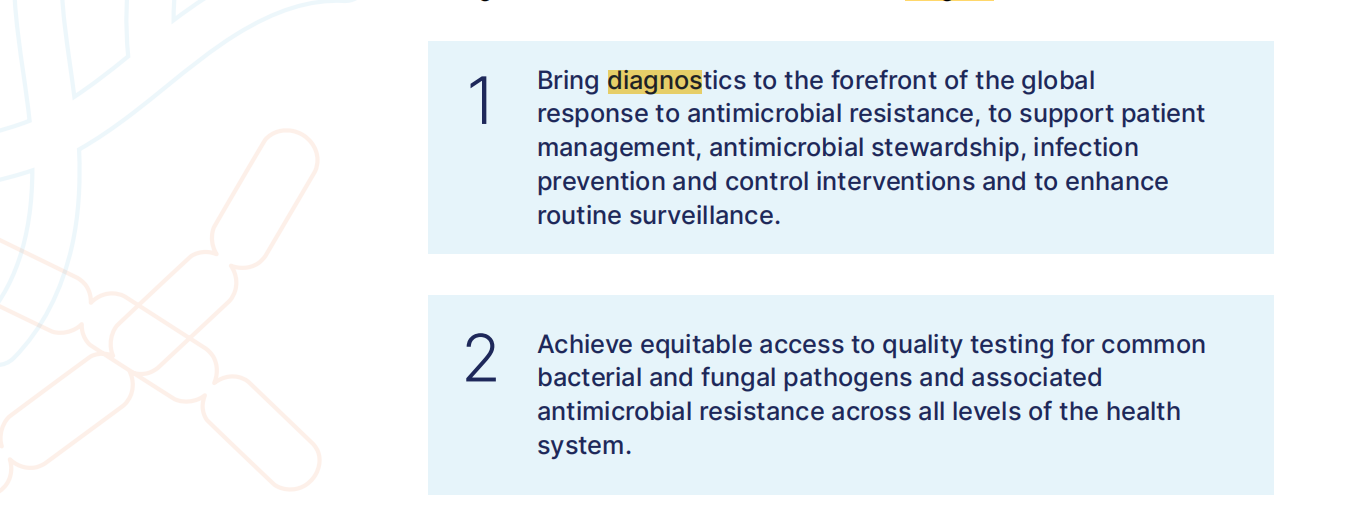
The WHO Global Action Plan on Antimicrobial Resistance identifies strengthening laboratory capacity and expanding access to quality diagnostics as key priorities for improving surveillance and optimizing antimicrobial use.

Building on this strategy, the WHO Antimicrobial Resistance Diagnostic Initiative (2024) highlights rapid diagnostics as a critical tool to:
- · Support antimicrobial stewardship (AMS)
- · Guide timely and appropriate antimicrobial therapy
- · Enable infection prevention and control (IPC)
- · Strengthen AMR surveillance
- · Improve outbreak detection and response
Similarly, the Infectious Diseases Society of America (IDSA) recommends rapid molecular diagnostics, where available, to identify bacterial pathogens and resistance mechanisms earlier, allowing clinicians to optimize antimicrobial therapy and reduce unnecessary exposure to broad-spectrum antibiotics.
The European Society of Clinical Microbiology and Infectious Diseases (ESCMID) also recommends rapid identification of carbapenemase-producing Gram-negative bacteria to facilitate early implementation of infection control measures and appropriate antimicrobial treatment.
Together, these international recommendations reinforce a common message: rapid molecular diagnostics are becoming an essential component of modern AMR management.
Understanding KPN, Aba and PA
Klebsiella pneumoniae (KPN)
K. pneumoniae is a major cause of healthcare-associated pneumonia, bloodstream infections, urinary tract infections, and sepsis.
Carbapenem-resistant K. pneumoniae frequently carries carbapenemase genes including:KPC, NDM, OXA-48-like and IMP.
Hypervirulent strains may combine enhanced virulence with multidrug resistance, creating significant therapeutic challenges.
Acinetobacter baumannii (Aba)
A. baumannii is highly resilient and capable of surviving on environmental surfaces for prolonged periods.
It is strongly associated with:
- · ICU outbreaks
- · Ventilator-associated pneumonia (VAP)
- · Bloodstream infections
- · Device-associated infections
Its remarkable ability to acquire resistance determinants has made carbapenem-resistant A. baumannii one of the most difficult hospital pathogens to treat.
Pseudomonas aeruginosa (PA)
P. aeruginosa is an opportunistic pathogen that commonly infects critically ill and immunocompromised patients.
Intrinsic resistance, rapid genetic adaptation, and biofilm formation contribute to persistent infections and increasing carbapenem resistance worldwide.
Transmission in Healthcare Settings
These multidrug-resistant pathogens are primarily transmitted through:
- · Contaminated medical equipment and environmental surfaces
- · Hands of healthcare workers
- · Colonized or infected patients
- · Respiratory secretions
- · Invasive devices such as ventilators and catheters
According to the U.S. Centers for Disease Control and Prevention (CDC), early laboratory detection combined with antimicrobial stewardship and rigorous infection prevention measures is essential for reducing healthcare-associated transmission of multidrug-resistant organisms.
Treatment Challenges
Treatment options continue to become more limited.
Current challenges include:
- · Increasing carbapenem resistance
- · Limited availability of novel antimicrobials
- · Toxicity associated with polymyxins
- · Emerging resistance to newer agents
Consequently, international guidelines consistently recommend obtaining timely microbiological evidence to support targeted antimicrobial therapy whenever possible.
Why Rapid Molecular Detection Matters
Conventional culture and antimicrobial susceptibility testing typically require 48–72 hours before actionable results become available.
Rapid molecular diagnostics can substantially shorten this timeline by simultaneously identifying pathogens and clinically important resistance genes, enabling earlier:
- · Appropriate antimicrobial therapy
- · Infection prevention interventions
- · Antimicrobial stewardship decisions
- · Surveillance of resistant organisms
A Multiplex PCR Solution for Faster Clinical Decision-Making
To support rapid identification of clinically important Gram-negative pathogens and carbapenem resistance mechanisms, Macro & Micro-Test’s KPN, Aba, PA & Drug Resistance Genes Multiplex Detection Kit simultaneously detects:
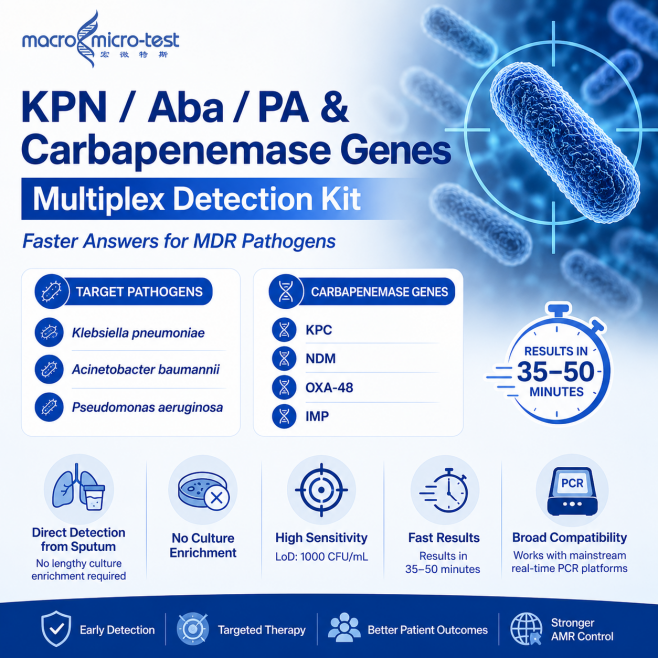
Target pathogens: Klebsiella pneumoniae, Acinetobacter baumannii, Pseudomonas aeruginosa
Carbapenemase genes: KPC, NDM, OXA-48, IMP
Key Features
- · Direct detection from sputum specimens
- · No lengthy culture enrichment required
- · Analytical sensitivity: LoD 1000 CFU/mL
- · Results available in 35–50 minutes
- · Compatible with mainstream real-time PCR platforms
By providing rapid molecular identification of pathogens and resistance markers, the assay can complement conventional microbiology workflows and support earlier clinical decision-making.
Working Together Against AMR
Antimicrobial resistance cannot be overcome through new antibiotics alone.
The WHO, IDSA, ESCMID, and CDC consistently emphasize that effective AMR control requires the integration of:
- · Rapid diagnostics
- · Antimicrobial stewardship
- · Infection prevention and control
- · Laboratory surveillance
- · Timely clinical intervention
As laboratories worldwide continue to strengthen their AMR response, rapid multiplex molecular diagnostics can play an increasingly important role in supporting evidence-based treatment decisions and helping reduce the spread of resistant pathogens.
References
1. Antimicrobial Resistance Collaborators. Global burden of bacterial antimicrobial resistance in 2019. The Lancet. 2022.
2. World Health Organization. Global Action Plan on Antimicrobial Resistance. 2015.
3. World Health Organization. WHO Bacterial Priority Pathogens List 2024.
4. World Health Organization. Antimicrobial Resistance Diagnostic Initiative. 2024.
5. Infectious Diseases Society of America (IDSA). 2024 Guidance on the Treatment of Antimicrobial-Resistant Gram-Negative Infections.
6. European Society of Clinical Microbiology and Infectious Diseases (ESCMID). Guidelines for the Management of Infections Caused by Multidrug-Resistant Gram-Negative Bacilli.
7. U.S. Centers for Disease Control and Prevention (CDC). Antibiotic Resistance Threats in the United States.
Post time: Jul-22-2026