
Recently, China CDC Weekly published an important research article describing the epidemiological and etiological investigation of an acute gastroenteritis outbreak caused by Group C rotavirus (RVC) at a primary school in Luzhou, Sichuan Province, in October 2025. Notably, Macro & Micro-Test’s high-throughput targeted pathogen capture kit (probe-capture) and whole-genome enrichment sequencing technology played a pivotal role in the investigation. By enabling accurate pathogen identification and comprehensive genomic characterization, the technology provided critical scientific evidence for rapid outbreak confirmation, precise source tracing, and effective outbreak control.
Sudden Outbreak: First Reported RVC Outbreak in Southwest China
On 15 October 2025, an acute gastroenteritis outbreak occurred at a primary school in Luzhou. The school had a total population of 1,943 students and staff, with 32 cases reported, including 6 laboratory-confirmed and 26 clinically diagnosed cases, resulting in an overall attack rate of 1.65%. The outbreak peaked between 15 and 16 October, with Class 7, Grade 5 experiencing the highest attack rate (23.08%). Most patients were school-aged children (median age: 10 years), presenting primarily with vomiting (65.62%), diarrhoea (46.87%), and abdominal pain (37.50%). Symptoms typically lasted 1–3 days, and all patients recovered without severe complications.
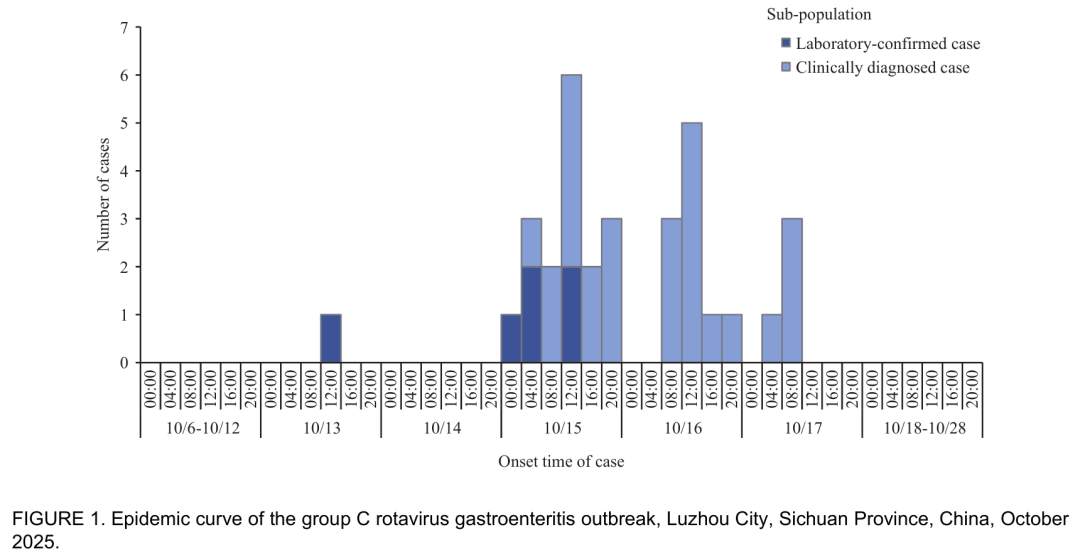
The epidemiological investigation identified the index case as an 11-year-old boy in Class 7, Grade 5. His younger sister had developed similar symptoms before him, suggesting household transmission as the initial source. Inadequate on-campus management of vomitus—including direct sweeping and disposal without timely disinfection or area isolation—combined with poor hand hygiene among students, likely facilitated further transmission. Most affected classrooms were located between the second and fifth floors and shared adjacent male restrooms, indicating that both aerosol and contact transmission may have contributed to the spread.
The investigation became particularly challenging because routine pathogen screening, including tests for norovirus and Group A rotavirus, yielded negative results, indicating that an uncommon pathogen was responsible.
Etiological Diagnosis: Macro & Micro-Test’s Whole-Genome Sequencing Identifies the Culprit
Initial testing for norovirus was negative. The Luzhou CDC subsequently employed a multiplex gastrointestinal pathogen real-time PCR assay capable of simultaneously detecting 28 pathogens, including 8 viruses, 17 bacteria, and 3 parasites, to screen eight clinical samples. On 17 October, six samples tested positive for Group C rotavirus, successfully identifying the causative pathogen.
To further trace the outbreak source, investigators performed both nanopore metagenomic sequencing and Macro & Micro-Test’s probe-capture whole-genome enrichment sequencing on five positive samples. This approach successfully generated five complete RVC genome sequences (SC01–SC05). The integrated strategy of rapid multiplex PCR screening followed by high-resolution whole-genome sequencing provided robust technical support for accurate molecular epidemiology and source tracing.
Scientific Insights: First Identification of the M2 Genotype in Southwest China
Based on the high-quality whole-genome data generated using Macro & Micro-Test’s technology, the research team reported several important scientific findings:
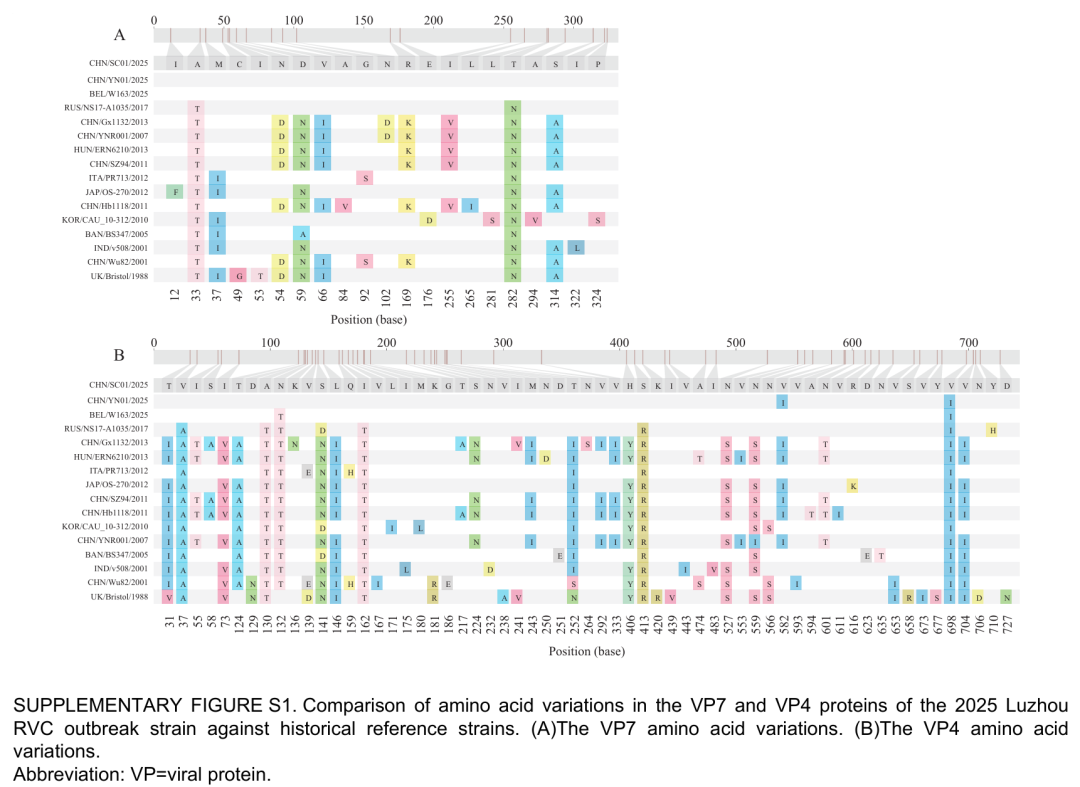
Confirmation of a monoclonal outbreak: All five viral isolates shared an identical whole-genome genotype (G4-P[2]-I2-R2-C2-M2-A2-N2-T2-E2-H2), with only 0–1 single nucleotide polymorphism (SNP) differences, conclusively demonstrating that the outbreak originated from a single transmission chain.
Discovery of the M2 genotype: Phylogenetic analysis revealed that the Luzhou RVC strains belonged to the M2 genotype rather than the M3 genotype previously considered predominant among Chinese RVC strains. This finding challenges the conventional understanding of RVC genotype distribution in China and confirms the emergence of the M2 genotype in southwest China.
Evidence of international transmission links: Whole-genome comparison demonstrated high genetic similarity between the Luzhou strains and RVC strains previously reported in Yunnan (2025), Novosibirsk, Russia (2017), and Italy (2012), suggesting the existence of an active Eurasian transmission network.
Implications for Prevention and Control: Early Detection and Rapid Intervention Are Essential
Following pathogen identification, the Luzhou CDC immediately implemented comprehensive control measures, including case isolation, environmental disinfection, standardized vomitus management, and temporary class suspension. The outbreak was successfully contained within a single incubation period, with no additional cases reported after 21 October.
The investigation also provides an important public health lesson: for clustered gastroenteritis outbreaks that test negative for both Group A rotavirus and norovirus, Group C rotavirus and other non-Group A rotaviruses should be incorporated into routine diagnostic screening.
This study represents the first reported Group C rotavirus outbreak in southwest China and the first identification of the M2 genotype in the region, expanding current understanding of RVC epidemiology in East Asia. In this investigation, Macro & Micro-Test’s integrated solution combining multiplex PCR screening with whole-genome enrichment sequencing demonstrated significant practical value by enabling both rapid pathogen identification and high-resolution molecular source tracing, providing a reproducible technical framework for the precise investigation and control of future infectious disease outbreaks.
Post time: Jul-30-2026