
On September 3, 2026, The New England Journal of Medicine (NEJM) published a correspondence reporting the discovery of Asian longhorned tick nairovirus (ALTNV), a novel tick-borne orthonairovirus identified by a research team from the State Key Laboratory of Pathogen and Biosecurity, Beijing.
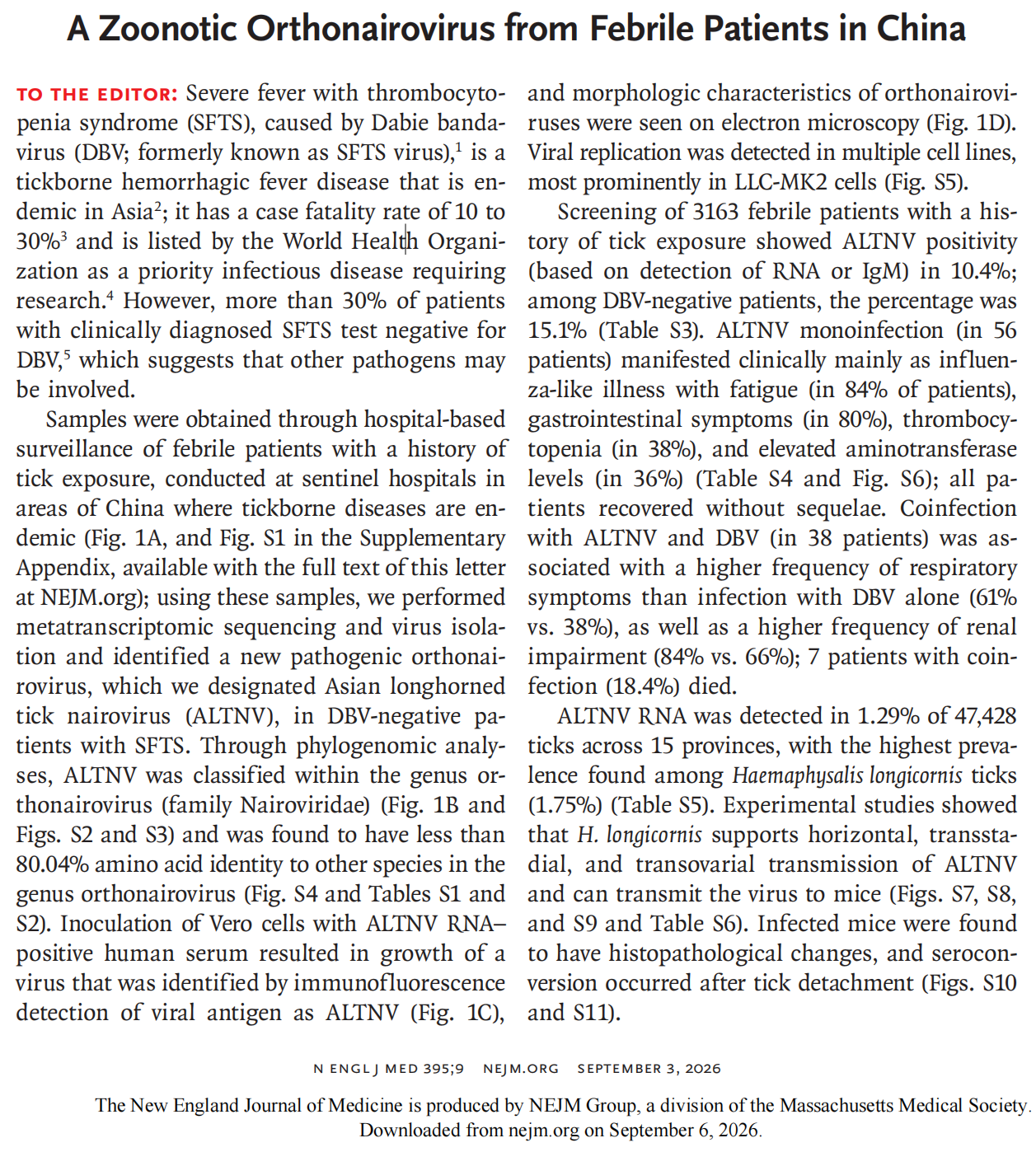
The discovery was made through the investigation of febrile patients with a history of tick exposure and marks the team’s third NEJM publication related to the discovery of novel zoonotic viruses, following Langya virus (LayV) in 2022 and Wetland virus (WELV) in 2024.
Behind these discoveries is a consistent scientific approach: when routine testing cannot explain a clinical picture, broaden the search, identify the unknown, and then validate it.
Macro & Micro-Test’s emerging pathogen discovery toolkit has supported this research pathway across these investigations, providing molecular tools for the identification and characterization of previously unknown viruses.
When SFTS Testing Is Negative, What Comes Next?
Severe fever with thrombocytopenia syndrome (SFTS) is a serious tick-borne disease caused by Dabie bandavirus (DBV). Yet a significant proportion of patients with clinical features of SFTS test negative for DBV.
This raises an important question:
If the suspected pathogen is not detected, what else could be causing the illness?
To investigate this unexplained clinical gap, researchers conducted active surveillance among febrile patients with a history of tick exposure in tick-borne disease-endemic areas of China.
By combining metatranscriptomic sequencing, pathogen screening, and virus isolation, the team identified ALTNV in DBV-negative patients. A custom-developed whole-genome probe-capture kit (HWKF-TW1041B) from Macro & Micro-Test was used to support the genomic investigation.
The finding demonstrates the value of moving beyond targeted pathogen testing when conventional diagnostic approaches cannot fully explain a clinical presentation.
What Is ALTNV?
Phylogenomic analysis placed ALTNV within the genus Orthonairovirus. Its amino acid identity was below 80.04% compared with other recognized species in the genus, supporting its classification as a distinct novel species.
Further laboratory investigation provided additional evidence. ALTNV-positive human serum was inoculated into Vero cells, resulting in virus isolation. Immunofluorescence and electron microscopy demonstrated characteristic orthonairovirus features, while viral replication was observed across multiple cell lines, with particularly prominent replication in LLC-MK2 cells.
Together, these findings established ALTNV as a previously unrecognized virus associated with human infection.
Three NEJM Publications, One Consistent Discovery Pathway
Looking across the 2022, 2024, and 2026 discoveries, a recognizable technical roadmap emerges:
2022 · Langya virus (LayV)
During surveillance of febrile patients with animal exposure in eastern China, high-throughput sequencing and virus isolation led to the identification of a novel henipavirus.
2024 · Wetland virus (WELV)
Following a case of persistent fever and multiple organ dysfunction after a tick bite in Inner Mongolia, next-generation sequencing helped reveal a previously unknown orthonairovirus.
2026 · Asian longhorned tick nairovirus (ALTNV)
Surveillance of febrile patients with tick exposure, combined with metatranscriptomic sequencing and virus isolation, identified a novel orthonairovirus among patients who tested negative for DBV.
Although the viruses and epidemiological settings differ, the underlying logic is remarkably consistent:
Start with the unexplained clinical or epidemiological signal → broaden pathogen detection through sequencing → identify potential novel agents → perform genomic and phylogenetic analysis → isolate and experimentally validate the pathogen.
This is the essence of reverse pathogenomics—using large-scale molecular data to work backward from unexplained disease signals toward previously unknown pathogens.
Macro & Micro-Test: Enabling the Search for the Unknown
Novel pathogen discovery requires more than a single detection assay. It requires a combination of broad screening, genomic characterization, bioinformatic analysis, and experimental validation.
Macro & Micro-Test’s emerging pathogen discovery solutions are designed to support this workflow, including:
- Large-scale sample screening across different seasons, hosts, and epidemiological settings
- High-throughput sequencing and viral metagenomic analysis for broad pathogen discovery
- Targeted probe-capture enrichment to support whole-genome characterization of emerging viruses
- Phylogenetic analysis to investigate viral evolution and relationships
- Bioinformatic screening and novel pathogen prediction to identify potential emerging threats from complex datasets
- Laboratory validation and virus isolation to support confirmation of newly identified pathogens
From Langya virus to Wetland virus to ALTNV, these technologies demonstrate how molecular tools can help transform an unexplained infection from “unknown” into “known.”
Why Does the ALTNV Discovery Matter?
The significance of ALTNV extends beyond the identification of another novel virus.
First, it helps address an important diagnostic gap.
ALTNV was identified among patients who were clinically suspected of having SFTS but tested negative for DBV, suggesting that other tick-borne pathogens may contribute to similar clinical presentations.
Second, it highlights the importance of differential diagnosis and co-infection.
The reported mortality associated with ALTNV and DBV co-infection was higher than that observed with DBV infection alone, emphasizing the need to consider multiple pathogens in patients exposed to tick-borne infections.
Third, it provides new insights into tick-borne virus ecology.
Evidence of horizontal, transstadial, and transovarial transmission suggests that ALTNV may be maintained within tick populations, warranting continued surveillance.
Finally, it reinforces the role of metagenomic and reverse pathogenomics approaches in emerging infectious disease surveillance.
When new pathogens emerge, the first challenge is often not knowing which test to order, but recognizing that the pathogen may not yet be on the test menu.
That is where broad, data-driven pathogen discovery becomes essential.
From the unknown to the known. From discovery to preparedness.
Macro & Micro-Test continues to support researchers with molecular tools that help expand the boundaries of pathogen detection and accelerate the discovery of emerging infectious threats.
Precise Diagnosis Shapes a Better Life.
References:
- Zhang XA, Li H, Jiang FC, Zhu F, Zhang YF, Chen JJ, Tan CW, Anderson DE, Fan H, Dong LY, Li C, Zhang PH, Li Y, Ding H, Fang LQ, Wang LF, Liu W. A Zoonotic Henipavirus in Febrile Patients in China. N Engl J Med. 2022 Aug 4;387(5):470-472.
- Zhang XA, Ma YD, Zhang YF, Hu ZY, Zhang JT, Han S, Wang G, Li S, Wang X, Tang F, Liang WJ, Yuan HX, Zhao JQ, Jiang LF, Zhang L, Si GQ, Peng C, Wang R, Ge HH, Li N, Jiang BG, Li C, Li H, Liu W. A New Orthonairovirus Associated with Human Febrile Illness. N Engl J Med. 2024 Sep 5;391(9):821-831.
- Zhang XA, Liu B, Wu SQ, Yang X, Cui N, Lin L, et al. A Zoonotic Orthonairovirus from Febrile Patients in China. N Engl J Med. 2026 Sep 3;395(9):930.
- Xu B, Liu L, Huang X, Ma H, Zhang Y, Du Y, Wang P, Tang X, Wang H, Kang K, Zhang S, Zhao G, Wu W, Yang Y, Chen H, Mu F, Chen W. Metagenomic Analysis of Fever, Thrombocytopenia and Leukopenia Syndrome (FTLS) in Henan Province, China: Discovery of a New Bunyavirus. PLoS Pathog. 2011 Nov;7(11):e1002369.
- Wang YL, Ma JM, Chen L, Zou YJ, Jiang JF. Application of Novel Metagenomic/Metatranscriptomic Technologies in Reverse Pathogenomics Research. Disease Surveillance. 2023;38(5):581-585. (in Chinese)
Post time: Sep-14-2026