
Global and regional molecular epidemiology of HIV-1 during 1990-2024:systematic review, global survey, and analysis of prevalence
Introduction
A recent study published in The Lancet Infectious Diseases (2026) provides the most comprehensive global analysis of HIV-1 molecular epidemiology to date, integrating systematic review data and a worldwide molecular surveillance survey.
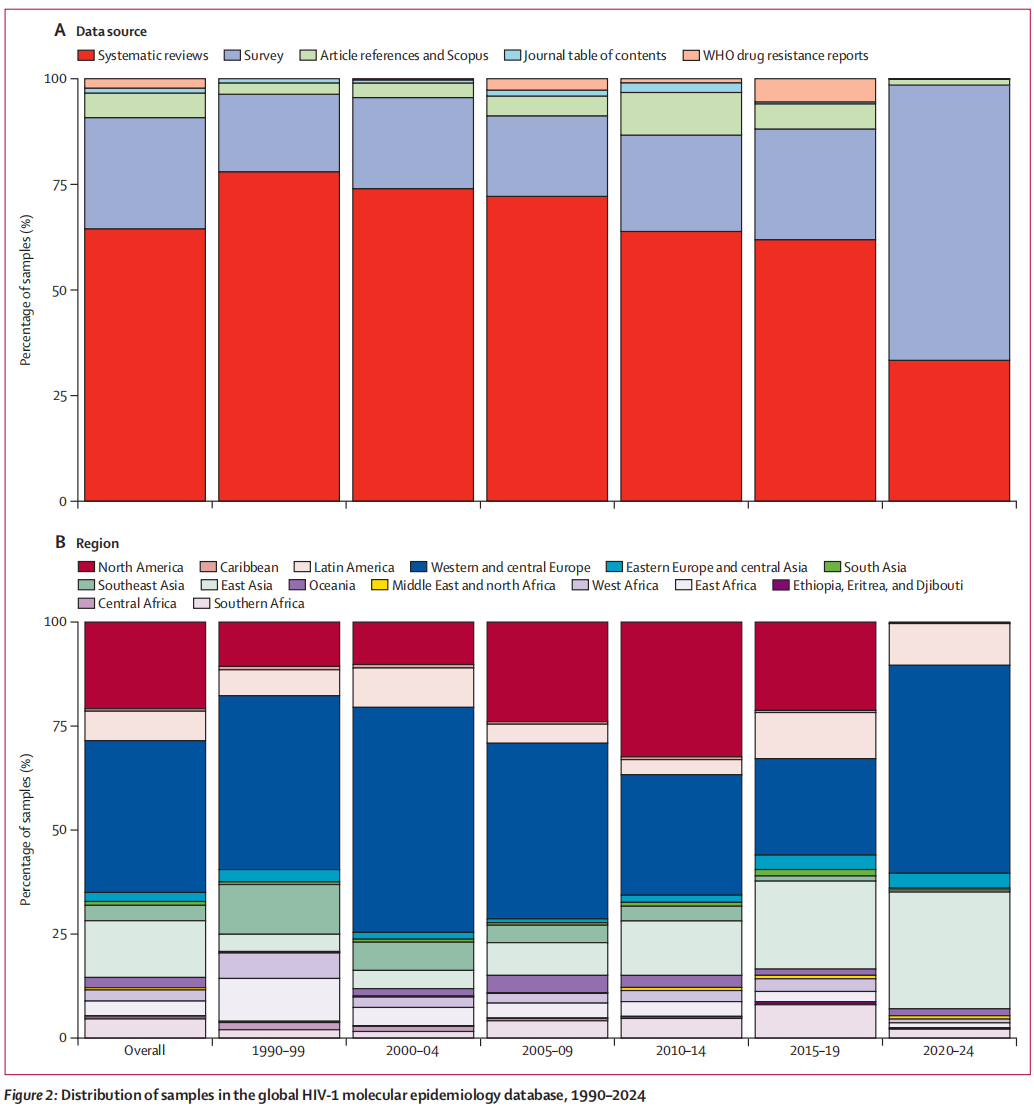
By combining previously available datasets (1990–2021) with newly collected sequence data, the study incorporated more than 1.39 million HIV-1 genotyping records from 154 countries collected between 1990 and 2024. Using UNAIDS-estimated numbers of people living with HIV as weighting factors, researchers generated global and regional maps describing the temporal and geographical distribution of HIV-1 subtypes, circulating recombinant forms (CRFs), and unique recombinant forms (URFs).
The findings demonstrate that although the global HIV-1 subtype landscape has remained relatively stable over the past two decades, substantial regional shifts are occurring, particularly driven by the increasing diversity and expansion of recombinant forms.
Study Background
Human immunodeficiency virus type 1 (HIV-1) exhibits extensive genetic diversity due to its high mutation rate, recombination capability, and long-term transmission dynamics.
This genetic variability has important implications for:
- · molecular surveillance,
- · diagnostic performance evaluation,
- · antiretroviral resistance monitoring,
- · and vaccine development strategies.
The study aimed to characterize the global and regional distribution patterns of HIV-1 subtypes and recombinant forms from 1990 to 2024, providing an updated molecular epidemiological framework for global HIV prevention and control.
Study Design and Methods
The researchers conducted a systematic review of PubMed, Embase, Global Health, CINAHL databases, covering studies published between January 1, 2022, and January 22, 2025.
In addition, data were collected through the Global HIV Molecular Epidemiology Collaboration network.
Eligible datasets included:
- · HIV-1 molecular subtype information,
- · clearly defined sampling locations,
- · collection dates,
- · and sufficient sample numbers.
The final dataset included:
- · 1,395,222 HIV-1 genotyping records
- · 154 countries
- · six epidemiological periods: 1990–1999, 2000–2004, 2005–2009, 2010–2014,2015–2019, 2020–2024.
The global and regional prevalence of HIV-1 genetic forms was estimated using UNAIDS-adjusted weighting methods.
Global Distribution of HIV-1 Subtypes: Subtype C Remains Dominant
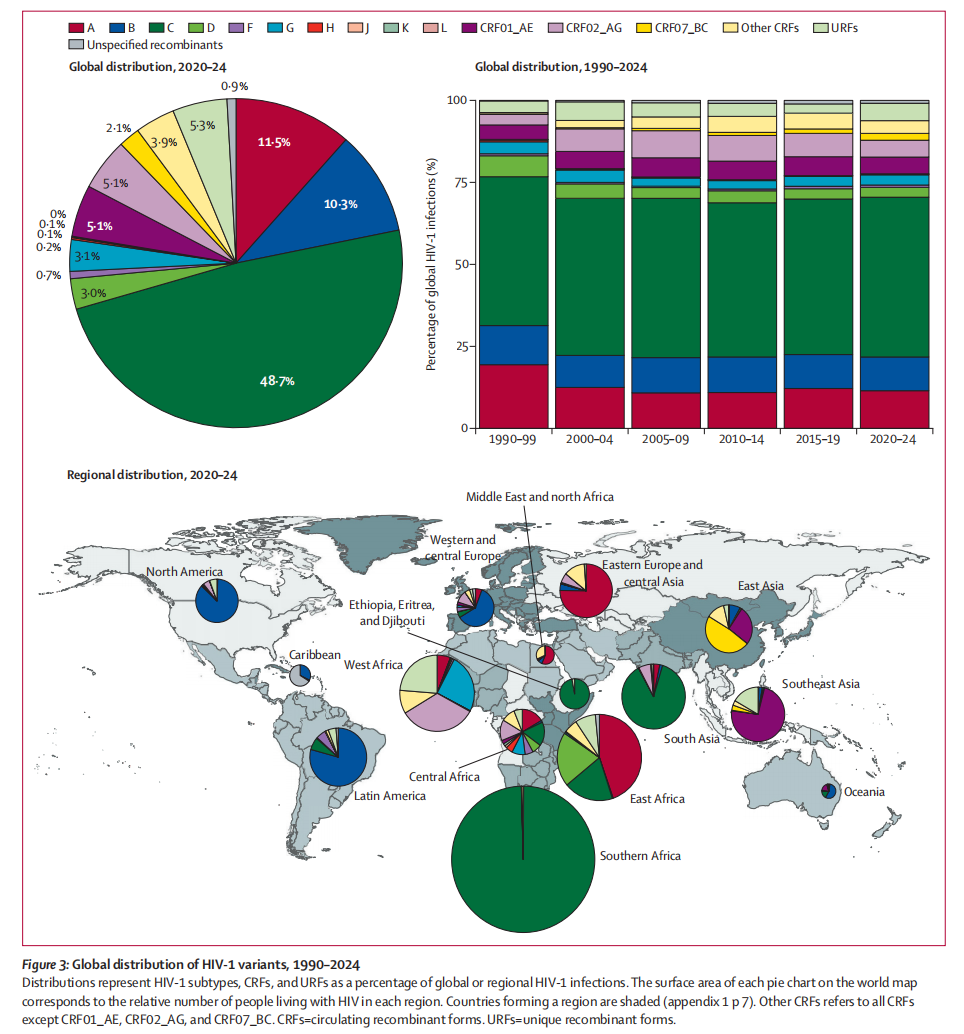
During 2020–2024, subtype C remained the predominant HIV-1 lineage worldwide, accounting for:
|
HIV-1 lineage |
Global proportion |
| Subtype C | 48.7% |
| Subtype A | 11.5% |
| Subtype B | 10.3% |
| URFs | 5.3% |
| CRF02_AG | 5.1% |
| CRF01_AE | 5.1% |
| Other CRFs | 3.9% |
| Subtype G | 3.1% |
| Subtype D | 3.0% |
| CRF07_BC | 2.1% |
Overall, recombinant forms (including CRFs and URFs) accounted for approximately 22.4% of global HIV-1 infections, highlighting the increasing complexity of HIV-1 genetic diversity.
Subtype C continues to dominate mainly in:
- · Southern Africa,
- · South Asia,
- · and several East African countries.
Because these regions contain a large proportion of the global HIV burden, the dominance of subtype C strongly influences the worldwide distribution pattern.
Regional Differences: Distinct Evolutionary Patterns Across Continents
Although the global HIV-1 structure appears relatively stable, regional patterns are undergoing substantial transformation.
Southern Africa and South Asia: Persistent Subtype C Dominance
Southern Africa and South Asia remain strongly characterized by subtype C circulation.
In these high-burden regions, subtype C represents the overwhelming majority of circulating viruses, making it the primary contributor to the global prevalence of subtype C.
However, the study also highlights that molecular sampling coverage in some high-burden regions remains limited, suggesting that additional surveillance efforts are needed to better capture local viral diversity.
North America and Latin America: Continued Subtype B Dominance
Subtype B remains the major circulating lineage in:
- · North America,
- · Latin America.
These regions demonstrate relatively stable molecular epidemiological patterns compared with regions undergoing more rapid subtype transitions.
Western and Central Europe: Increasing Genetic Diversity
Western and Central Europe are experiencing a gradual transition from a predominantly subtype B epidemic toward a more diverse viral landscape.
Key trends include:
- · declining proportion of subtype B,
- · increasing contribution of recombinant forms,
- · growing presence of non-B lineages.
These changes indicate that HIV-1 molecular diversity is becoming increasingly important even in historically subtype B–dominant regions.
East Asia: Rapid Expansion of Recombinant Forms
East Asia showed one of the most significant epidemiological shifts.
The study found that:
- · CRF07_BC increased substantially over time,
- · subtype B declined markedly.
CRF07_BC increased from approximately 13.1% during 2000–2004 to 48.1% during 2020–2024, demonstrating a major change in regional HIV-1 molecular epidemiology.
This transformation highlights the importance of continuous molecular surveillance in regions where recombinant forms are becoming dominant.
Recombinant Forms: A Growing Component of Global HIV-1 Diversity
The proportion of recombinant forms increased globally over previous decades:
- · 2000–2004: approximately 20.8%
- · 2010–2014: approximately 24.2%
- · 2020–2024: approximately 22.4%
Although the global proportion slightly declined in the most recent period, recombinant forms continue to expand in several regions, particularly:
- · East Asia,
- · Western and Central Europe.
The study suggests that recombinant forms may still be underestimated in some settings because many surveillance programs rely mainly on partial genomic regions, which may not fully identify complex recombination patterns.
Strengthening genomic surveillance approaches will therefore be important, particularly in regions with high HIV transmission burden and increasing viral diversity.
Public Health and Clinical Implications
1. Diagnostic Systems Require Continuous Cross-Subtype Evaluation
Increasing HIV-1 genetic diversity highlights the importance of ongoing evaluation of diagnostic technologies across diverse viral backgrounds.
Although current HIV diagnostic and viral load testing platforms have demonstrated broad applicability, continuous validation against emerging subtypes and recombinant forms remains essential.
Future surveillance should integrate:
- · molecular epidemiology,
- · diagnostic performance monitoring,
- · and viral evolution analysis.
2. Drug Resistance Surveillance Needs Broader Genetic Coverage
The expansion of diverse HIV-1 lineages may influence the emergence, detection, and interpretation of resistance-associated mutations.
Some studies have suggested that specific HIV-1 lineages, including A6/A1-related variants, may be associated with increased risk of virological failure under certain long-acting cabotegravir/rilpivirine treatment settings.
However, resistance outcomes are influenced by multiple factors, including:
- · baseline resistance mutations,
- · treatment history,
- · adherence,
- · and viral genetic background.
Therefore, subtype-aware resistance surveillance remains increasingly important.
3. Vaccine Development Must Consider Regional Viral Diversity
The extensive genetic diversity of HIV-1 remains one of the major challenges for vaccine development.
The evolving distribution of subtypes and recombinant forms highlights the need for vaccine strategies that consider:
- · regional circulating strains,
- · viral evolutionary trends,
- · and broader immune coverage.
A globally uniform approach may not fully address the diversity of HIV-1 circulating worldwide.
Conclusion
This landmark global analysis of HIV-1 molecular epidemiology demonstrates that the worldwide viral landscape is characterized by both continuity and change.
While subtype C continues to account for nearly half of global HIV-1 infections, regional molecular patterns are rapidly evolving, with recombinant forms increasingly shaping epidemics in areas such as East Asia and Europe.
The findings reinforce the importance of sustained molecular surveillance, cross-subtype diagnostic validation, and integrated genomic approaches to support effective HIV prevention, treatment monitoring, and future vaccine development.
Reference
1. Global and regional molecular epidemiology of HIV-1 during 1990–2024: systematic review, global survey, and analysis of prevalence. The Lancet Infectious Diseases, 2026.
Post time: Jul-24-2026