
One flu negative result can answer one question. It may not explain the illness.
A patient presents with fever, cough and sore throat.
The influenza test is negative.
What does that actually tell us?
It tells us that influenza was not detected by that particular test.
It does not tell us which respiratory pathogen is causing the illness.
That matters because COVID-19, influenza, RSV and adenovirus can all cause overlapping respiratory symptoms. The US CDC lists all four among common viral respiratory illnesses, while noting that adenovirus can cause anything from cold- or flu-like illness to bronchitis and pneumonia.
These five pathogens don’t circulate the same way
As of September 2026, the respiratory season has not yet reached widespread activity across the EU/EEA or the United States.
CDC’s latest data show low influenza activity and very low RSV activity nationally, while COVID-19 activity remains elevated but is declining. ECDC similarly reports that most EU/EEA countries remain at baseline, with influenza and RSV at low or inter-epidemic levels.
But the previous season demonstrated an important point:
Respiratory viruses do not necessarily peak at the same time.
During the 2025–2026 US season, influenza, COVID-19 and RSV reached their hospitalization peaks at different points in the season.
And adenovirus follows a different pattern altogether.
Unlike influenza and RSV, respiratory adenoviruses (Adv) circulate year-round in the United States, according to CDC. They commonly cause cold- or flu-like illness and can also cause acute bronchitis, pneumonia and conjunctivitis.
So the five pathogens most relevant to a broad respiratory testing strategy — COVID-19, influenza A and B, RSV and adenovirus — each follow their own circulation pattern. Some peak in winter, some fluctuate throughout the year, and at least one does not wait for the season at all.
A testing strategy built around a single pathogen can leave unanswered questions as these patterns shift.
What circulates year-round matters too
Adenovirus is a useful illustration of why seasonal thinking alone is not enough.
CDC maintains dedicated surveillance through NREVSS and NATRS, tracking respiratory adenovirus activity and adenovirus types.
ECDC takes a broader surveillance approach: its 2026 integrated respiratory virus framework focuses routine surveillance on influenza, SARS-CoV-2 and RSV, while also recognising other respiratory pathogens as part of the wider acute respiratory illness landscape. ECDC has specifically highlighted adenovirus clusters as respiratory events that can place additional pressure on healthcare systems.
The message is simple:
What circulates seasonally is important. What circulates year-round matters too.
And both need to be considered when deciding how broadly to test.
One respiratory sample can answer more than one question
This is where multiplex testing becomes relevant.
The principle is not that every patient needs every possible pathogen tested.
It is that testing coverage should match the clinical and epidemiological question.
From one target to a flexible respiratory portfolio
Different testing settings need different levels of coverage.
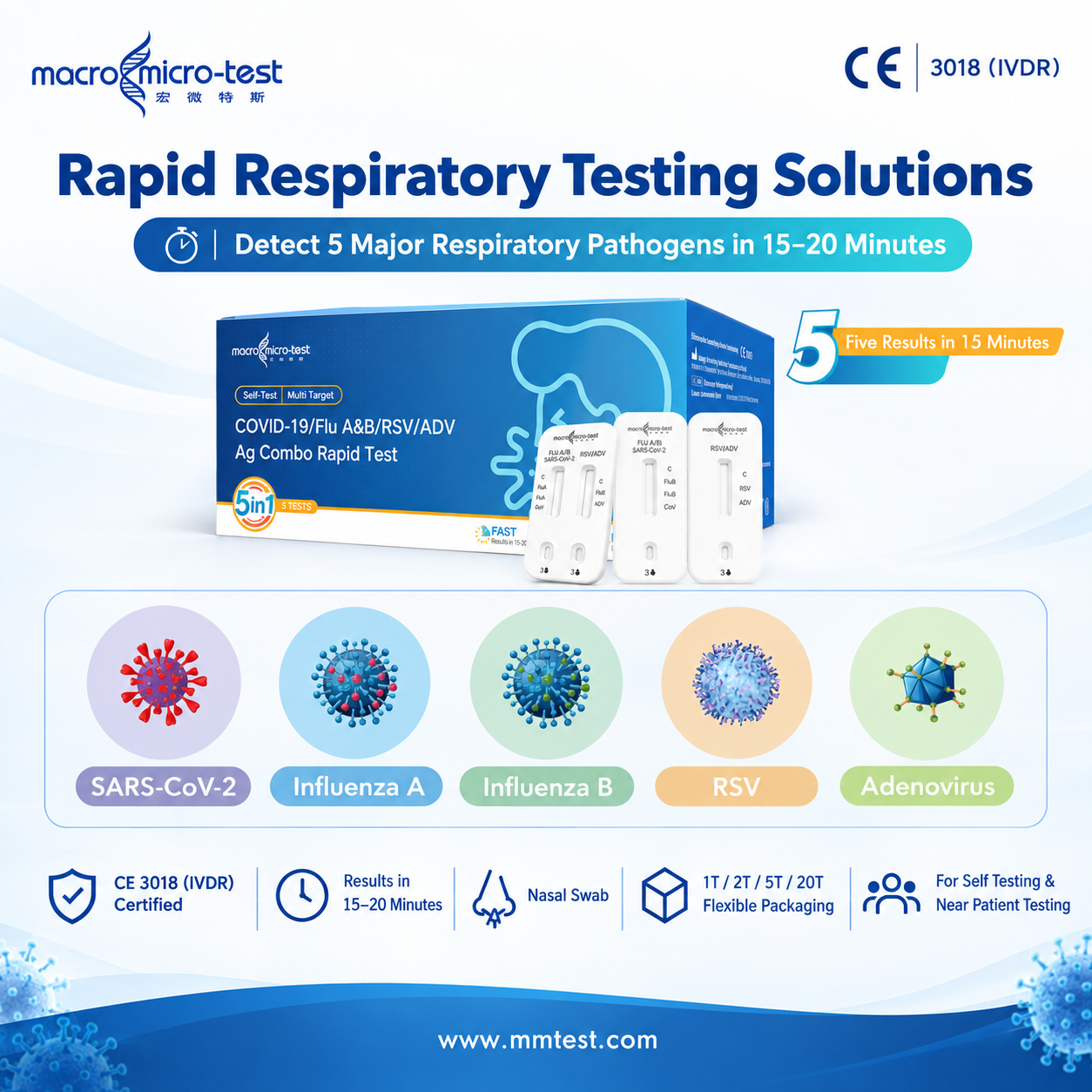
5-in-1
COVID-19 + Flu A/B + RSV + Adenovirus
3-in-1
COVID-19 + Flu A/B
2-in-1
RSV + Adenovirus
The advantage of a portfolio approach is flexibility: broader coverage when more pathogens need to be considered, and focused combinations when a narrower testing question is appropriate.
The question is no longer only “Is it flu?”
A more useful question may be:
“Which respiratory pathogen could be causing these symptoms — and what level of testing coverage do we need?”
As the 2026–2027 respiratory season approaches, preparing the right testing options is part of preparing for the season itself.
One swab. Multiple targets. More answers.
Test early. Know more. Act earlier.
Post time: Sep-30-2026