
Antimicrobial resistance (AMR) is an increasingly urgent global health challenge. It threatens the effectiveness of essential antibiotics, complicates the treatment of common infections and places growing pressure on healthcare systems worldwide.
The WHO Global Antibiotic Resistance Surveillance Report 2025 highlights two closely related concerns: the growing burden of antibiotic resistance and significant disparities in resistance patterns and surveillance capacity across regions.
These findings reinforce an important priority: tackling AMR requires not only responsible antimicrobial use and effective infection prevention, but also wider access to timely, reliable and comprehensive diagnostic solutions.
1. AMR Is Growing, but Its Impact Is Not Evenly Distributed
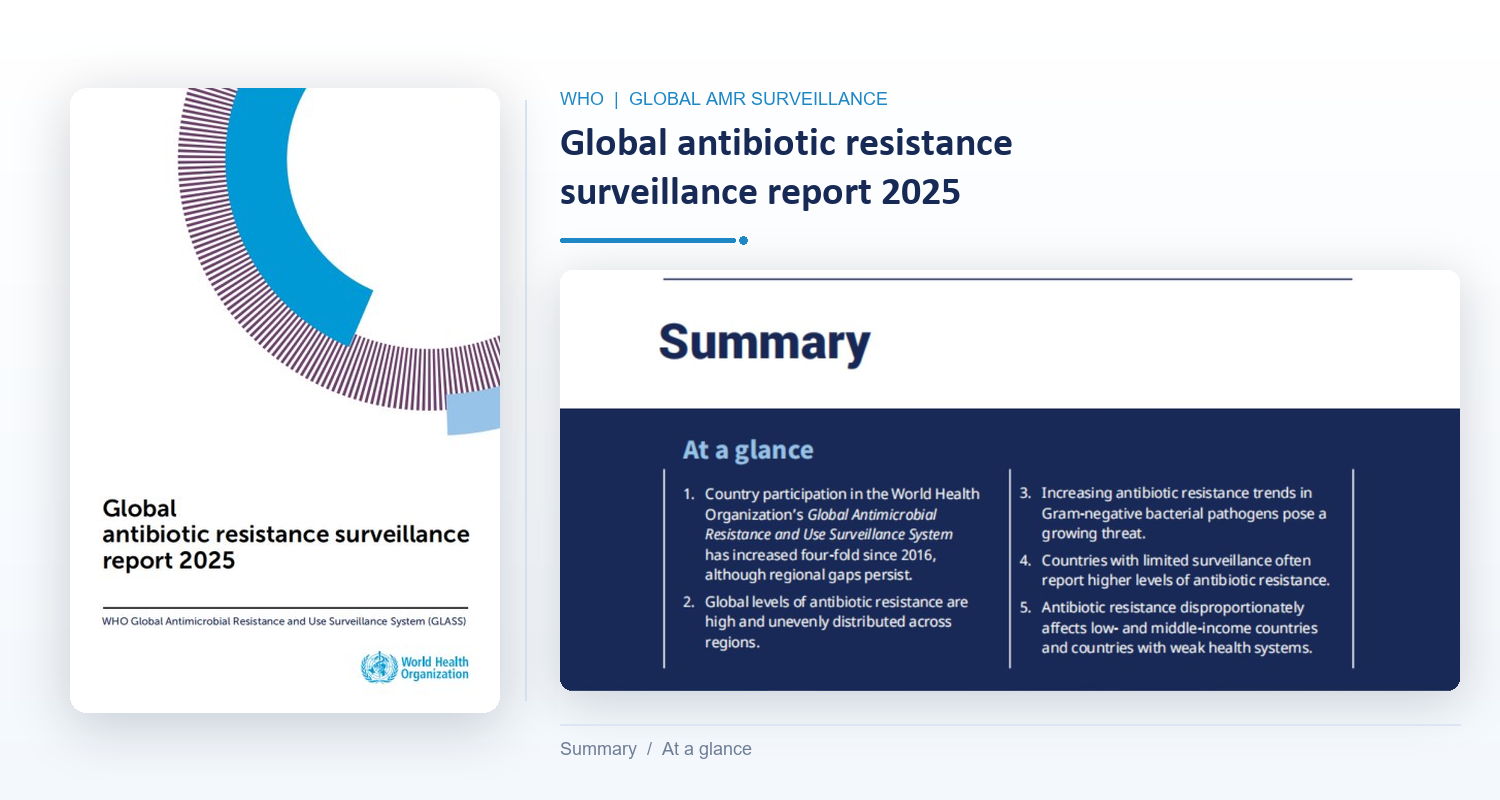
Based on more than 23 million bacteriologically confirmed infection cases, the WHO 2025 report reveals several concerning trends in global antibiotic resistance.
High and rising resistance levels
In 2023, approximately one in six laboratory-confirmed bacterial infections causing common infections worldwide was resistant to antibiotic treatments. Between 2018 and 2023, resistance increased in more than 40% of the pathogen-antibiotic combinations monitored by WHO, with average annual increases ranging from 5% to 15%.
Significant regional disparities
Antibiotic resistance is not distributed equally around the world. Differences in healthcare infrastructure, antibiotic use, infection prevention practices and access to microbiological testing contribute to substantial regional variations.
For example, resistance to third-generation cephalosporins exceeds 70% in some African settings for key Gram-negative pathogens, illustrating the scale of the challenge in certain regions.
Growing threats from Gram-negative pathogens
The increasing resistance of pathogens such as Klebsiella pneumoniae, Acinetobacter baumannii and Pseudomonas aeruginosa is particularly concerning. These bacteria are important causes of healthcare-associated infections. Their resistance to critical antibiotics, including carbapenems, can significantly limit available treatment options.
As a result, identifying these pathogens and detecting their resistance mechanisms have become increasingly important for clinical decision-making and infection control.
2. The Surveillance Gap: More Participation, but Uneven Capacity
The expansion of the WHO Global Antimicrobial Resistance and Use Surveillance System (GLASS) represents important progress in global AMR monitoring. Country participation has increased more than four-fold, from 25 countries in 2016 to 104 countries reporting AMR data in 2023.
However, greater participation does not necessarily translate into adequate surveillance coverage.
Regional gaps remain substantial. In 2023, only 20% of Member States in the WHO Region of the Americas and 37% in the Western Pacific Region reported AMR data to GLASS. Meanwhile, approximately half of reporting countries still lacked the systems needed to generate reliable surveillance data.
Countries with limited surveillance capacity often face greater difficulties in identifying and accurately assessing resistance patterns. This is particularly concerning in low- and middle-income countries, where gaps in laboratory infrastructure and healthcare resources can further restrict access to microbiological diagnostics.
Without sufficient testing capacity, emerging resistance patterns may go undetected or be underrepresented in surveillance data. This can leave healthcare professionals with less information for clinical decisions and public health authorities with an incomplete picture of the AMR burden.
Strengthening AMR surveillance therefore requires more than data reporting. It also requires broader access to reliable diagnostic testing.
3. Why Diagnostic Accessibility and Testing Coverage Matter
Effective AMR management depends on identifying the pathogens responsible for infections and determining whether they carry clinically important resistance mechanisms.
Yet healthcare facilities differ considerably in their laboratory infrastructure, testing volumes, technical capabilities and available resources. While larger reference laboratories may have access to advanced molecular platforms, smaller hospitals and laboratories may face limitations in equipment, personnel and testing budgets.
Expanding diagnostic access requires solutions that address these different needs.
Three considerations are particularly important:
-Timeliness: Faster detection of pathogens and resistance markers can support clinical decision-making and infection control.
-Testing coverage: Broader detection of clinically important pathogens and resistance genes can provide more comprehensive information about resistance threats.
-Platform flexibility: Compatibility with existing laboratory equipment, alongside integrated testing options, can help more healthcare facilities adopt appropriate diagnostic workflows.
From rapid screening of key resistance enzymes to multiplex molecular detection of pathogens and resistance genes, a diverse range of testing solutions can help address different laboratory requirements.
This is where accessible and adaptable diagnostic technologies become particularly valuable.
4. Macro & Micro-Test: AMR Diagnostic Solutions Across Different Testing Needs
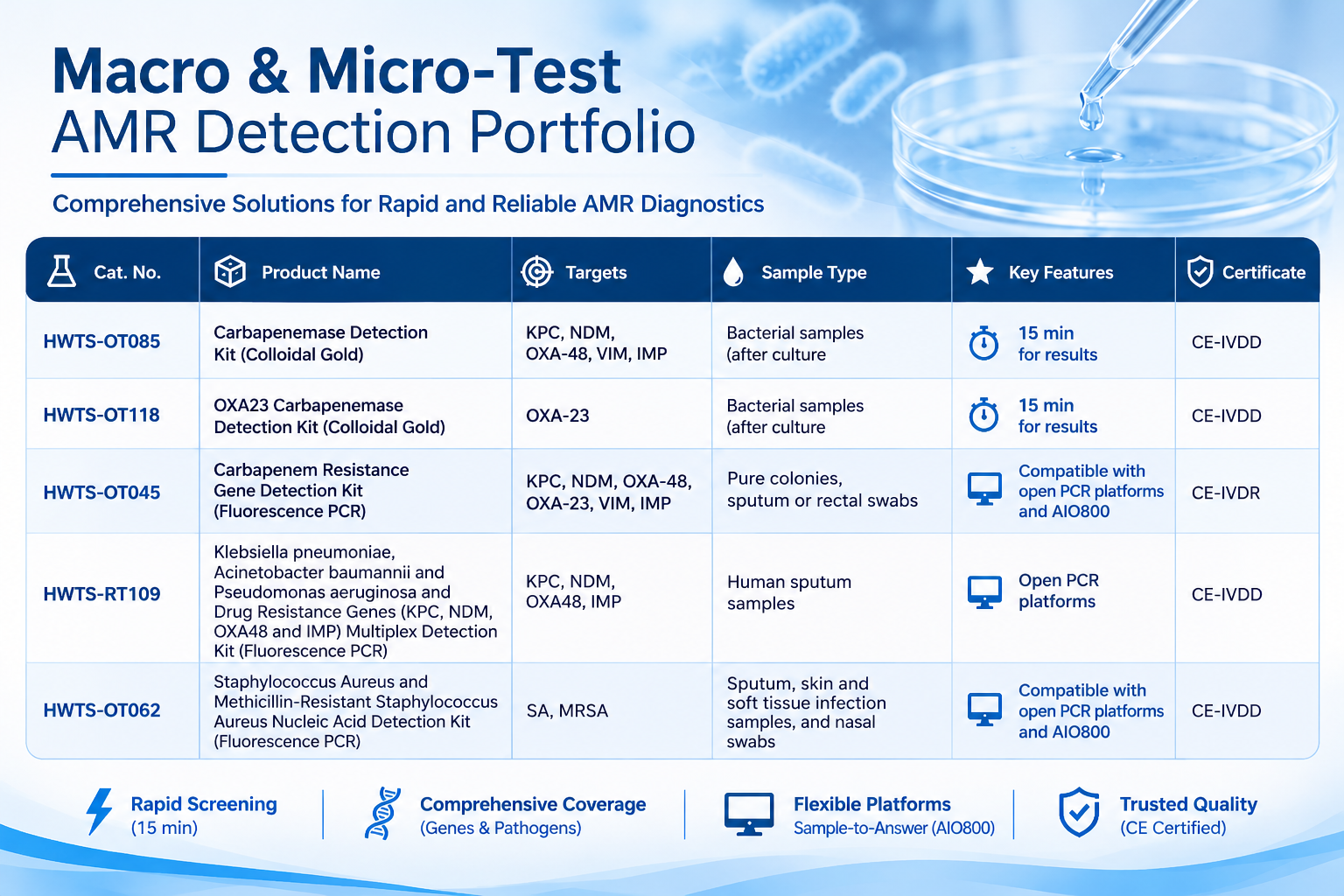
Macro & Micro-Test offers a portfolio of AMR-related diagnostic solutions covering rapid carbapenemase screening, multiplex resistance gene detection, and combined pathogen and resistance gene testing. The portfolio includes solutions for both Gram-negative and Gram-positive bacterial threats.
1) Rapid Carbapenemase Detection: Screening Key Resistance Enzymes
Rapid identification of major carbapenemases can provide valuable information for resistance screening and infection control.
Macro & Micro-Test offers two colloidal gold-based solutions:
- Carbapenemase Detection Kit (Colloidal Gold): Detects five major carbapenemases: KPC, NDM, OXA-48, VIM and IMP.
- OXA-23 Carbapenemase Detection Kit (Colloidal Gold): Specifically detects OXA-23.
Both kits deliver results in approximately 15 minutes using bacterial samples obtained after culture, providing a rapid screening option for key carbapenemases within existing laboratory workflows.
2) Multiplex Carbapenem Resistance Gene Detection: Six Key Targets
For laboratories requiring molecular detection of multiple carbapenem resistance genes, Macro & Micro-Test offers the Carbapenem Resistance Gene Detection Kit (Fluorescence PCR).
The assay covers six major resistance genes:KPC, NDM, OXA-48, OXA-23, VIM and IMP.
CE-IVDR certified, the kit supports testing of pure colonies, sputum and rectal swab samples without prior culture. It is compatible with conventional open fluorescence PCR platforms and the AIO800 molecular POCT system, offering flexibility for different laboratory workflows.
3) Combined Pathogen and Resistance Gene Detection: A More Comprehensive Molecular Approach
Identifying resistance genes is important, but knowing which pathogens are involved provides additional information for infection assessment.
Macro & Micro-Test’s multiplex Fluorescence PCR assay combines the detection of three clinically important Gram-negative pathogens with four major carbapenem resistance genes in human sputum samples.
Pathogen targets: Klebsiella pneumoniae, Acinetobacter baumannii and Pseudomonas aeruginosa
Resistance gene targets: KPC, NDM, OXA-48,and IMP.
CE-IVDD certified and compatible with conventional open fluorescence PCR platforms and the AIO800, the assay integrates pathogen identification and resistance gene detection into one testing workflow.
By combining these targets, it supports a more comprehensive molecular assessment of important Gram-negative bacterial threats.
4) Staphylococcus aureus and MRSA Detection: Addressing Gram-Positive Bacterial Resistance
Beyond Gram-negative bacteria, antimicrobial resistance among Gram-positive pathogens also remains an important concern. Staphylococcus aureus, particularly methicillin-resistant Staphylococcus aureus (MRSA), is a significant cause of both healthcare-associated and community-associated infections.
To address this diagnostic need, Macro & Micro-Test offers the SA & MRSA Detection Kit. The assay simultaneously detects Staphylococcus aureus (SA) and methicillin-resistant Staphylococcus aureus (MRSA), supporting testing of sputum, skin and soft tissue infection samples, and nasal swabs.
Compatible with both conventional open fluorescence PCR platforms and the AIO800 POCT system, the assay offers flexible testing options. On the AIO800, it supports an integrated Sample-to-Answer workflow.
This extends the portfolio’s molecular detection capabilities to both Gram-negative and Gram-positive bacterial threats.
5. Flexible Testing Options, Broader Diagnostic Access
From rapid carbapenemase screening to multiplex molecular detection, Macro & Micro-Test provides different approaches to address key AMR testing needs.
The Fluorescence PCR assays are compatible with conventional open PCR platforms, with selected kits also supporting the AIO800 integrated sample-to-result system. Laboratories can therefore make use of their existing molecular testing infrastructure or adopt a more integrated workflow.
By combining different testing methods, target coverage and platform options, Macro & Micro-Test aims to make molecular diagnostics more adaptable to diverse laboratory settings.
6. Strengthening the AMR Response Through Better Diagnostics
The WHO Global Antibiotic Resistance Surveillance Report 2025 highlights a fundamental challenge: AMR is a global threat, but the capacity to detect and monitor it remains unevenly distributed.
Addressing this gap requires not only stronger surveillance systems, but also accessible diagnostic technologies that support timely detection and broader testing coverage.
At Macro & Micro-Test, we believe that expanding access to reliable and flexible diagnostic solutions is an important part of the global response to antimicrobial resistance.
Because a stronger response to AMR starts with the ability to detect it — accurately, efficiently and across more healthcare settings.
Macro & Micro-Test — Precise Diagnosis Shapes A Better Life.
Post time: Nov-18-2026