
Nearly Half the World’s Population May Be Infected. But H. pylori Testing Is More Than a Single Test.
In 1982, Barry Marshall and Robin Warren identified and cultured Helicobacter pylori from gastric biopsy specimens, fundamentally changing our understanding of peptic ulcer disease. Their discovery, recognized with the 2005 Nobel Prize in Physiology or Medicine, established that a bacterial infection could be a major cause of peptic ulcer disease.
But the significance of H. pylori goes far beyond ulcers.
H. pylori is classified by IARC as a Group 1 carcinogen and is the primary cause of gastric cancer. Infection is widespread globally, while many infected individuals have few or no obvious symptoms. This makes detection an important part of gastric cancer prevention.
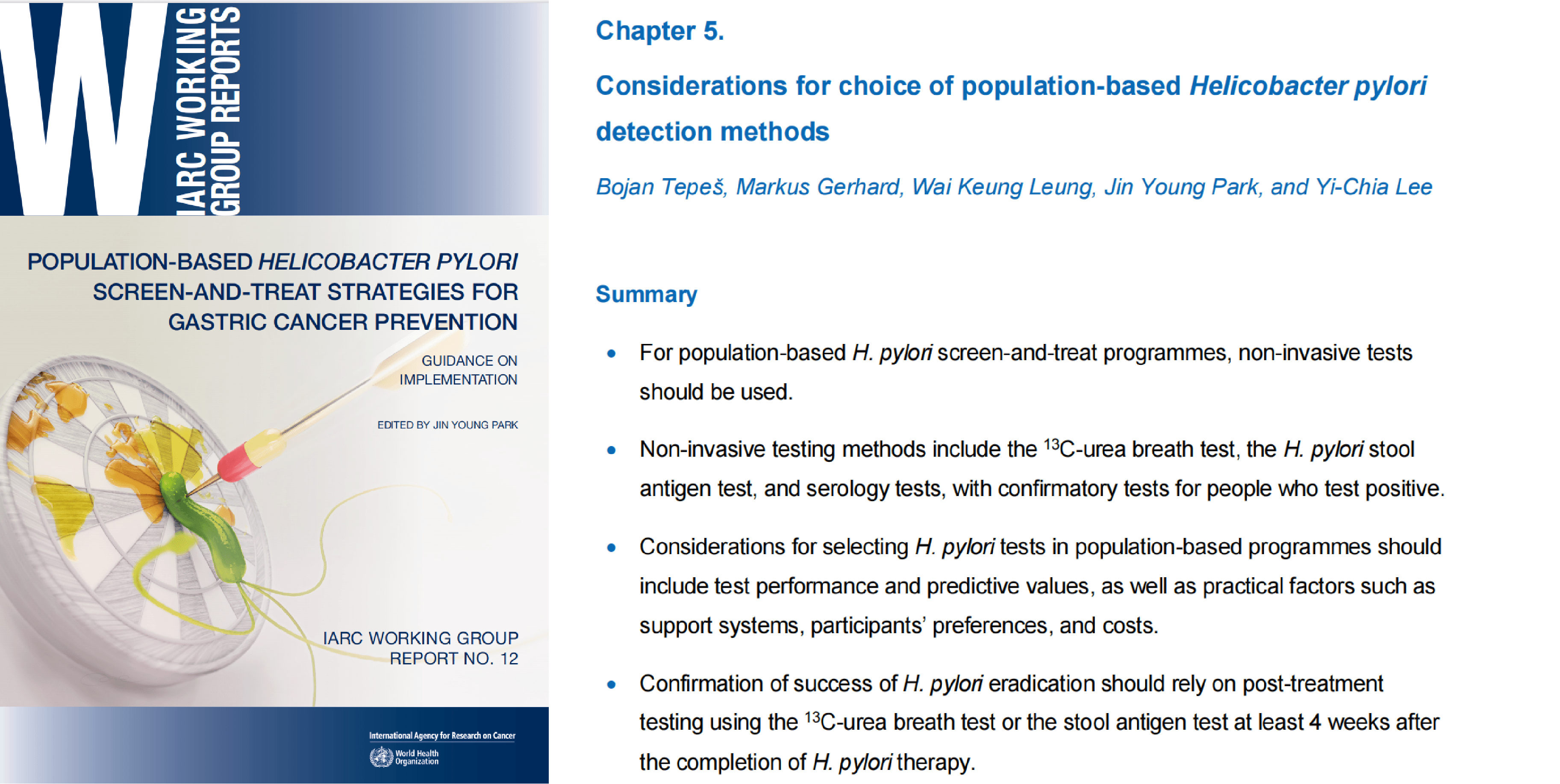
In recent years, international recommendations have increasingly emphasized screen-and-treat strategies for H. pylori. The 2025 IARC guidance identified population-based screening and treatment as an important approach to gastric cancer prevention, while the Taipei Global Consensus II recognized 13C-urea breath testing and stool antigen testing as preferred non-invasive approaches for H. pylori screening.
But screening is only the beginning.
The more important question is: What does the clinician need to know at each stage of the patient journey?
From Clinical Questions to a Testing Pathway
Not every H. pylori test answers the same clinical question. The appropriate approach depends on what needs to be determined at each stage of the patient journey—from identifying active infection to obtaining molecular information and confirming eradication after treatment.
Is there an active infection?
For screening and diagnosis, stool antigen testing and the 13C-urea breath test are established non-invasive approaches for detecting active H. pylori infection.
The two methods provide similar clinical information but differ in their testing requirements. A 13C-urea breath test generally requires dedicated testing equipment, whereas a stool antigen test based on colloidal gold technology does not require a specialized instrument.
This makes stool antigen testing particularly practical when testing needs to be simple, decentralized, and accessible in settings without dedicated breath-test analyzers.
The same question also becomes important after treatment: Is active H. pylori infection still present?
Because the presence of active infection can be assessed both before treatment and after treatment, stool antigen testing can be used for initial detection as well as post-treatment confirmation of eradication.
What molecular characteristics does the infection carry?
Once H. pylori is detected, molecular testing can provide additional information beyond pathogen presence.
For example, cagA is an important virulence-associated marker that can be detected alongside H. pylori. This adds another layer to the clinical question:
“Is H. pylori present?” → “What molecular characteristics does the detected strain carry?”
Has the patient been exposed to H. pylori?
Serological testing addresses a different question.
Antibody tests detect the immune response to H. pylori. Because antibodies may persist after the infection has been cleared, serology cannot reliably distinguish active infection from previous exposure.
Its clinical role therefore differs from tests designed to detect active infection.
Taken together, these testing approaches can support different points along the H. pylori journey:
Screening → Diagnosis → Characterization → Treatment → Confirmation
The key is not to use one test for every stage, but to select the testing technology that matches the clinical question.
Four Testing Solutions for Different Clinical Questions
Based on these different testing needs, Macro & Micro-Test offers four H. pylori testing solutions covering active infection, molecular detection, virulence profiling, and antibody testing.
HWTS-OT058 | H. pylori Stool Antigen Test
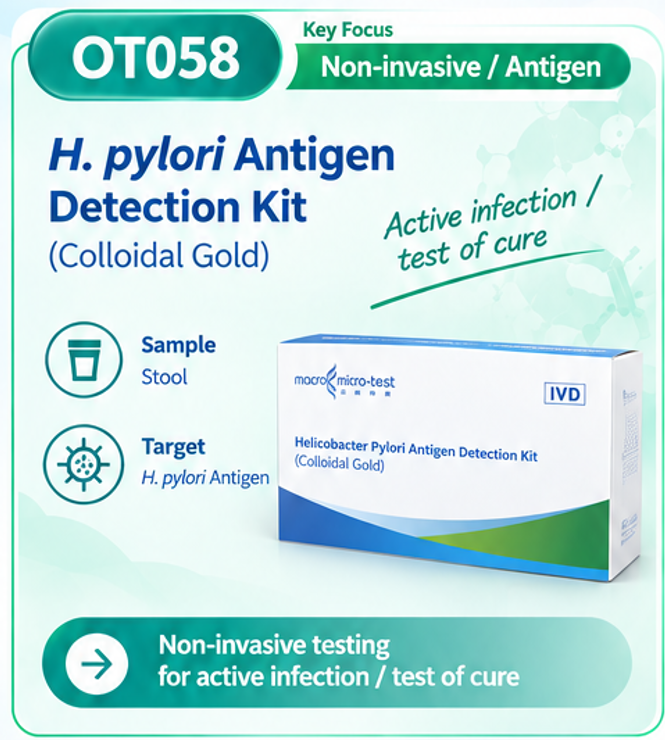
A non-invasive, instrument-free option for detecting active H. pylori infection.
It can support both initial detection and post-treatment confirmation of eradication, providing a practical solution for decentralized testing.
HWTS-OT139 | H. pylori + cagA Detection Kit
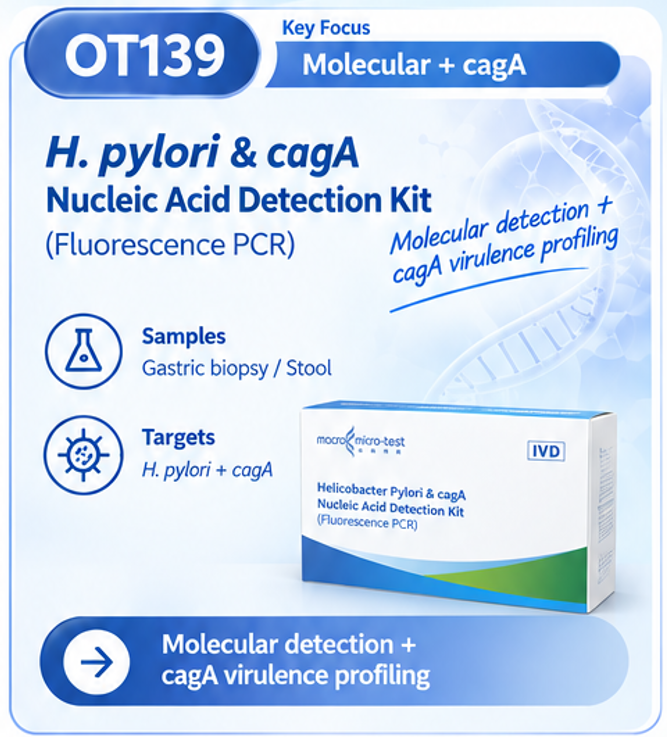
A molecular solution for simultaneous detection of H. pylori and cagA.
It combines pathogen detection with information on an important virulence-associated marker, providing additional molecular characterization.
HWTS-OT075 | H. pylori Detection Kit
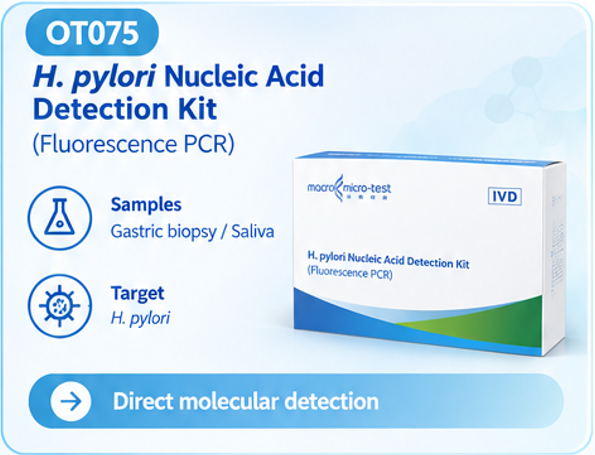
A fluorescence PCR-based molecular assay for direct detection of H. pylori, providing a molecular testing option when nucleic acid detection is required.
HWTS-OT059 | H. pylori Antibody Test
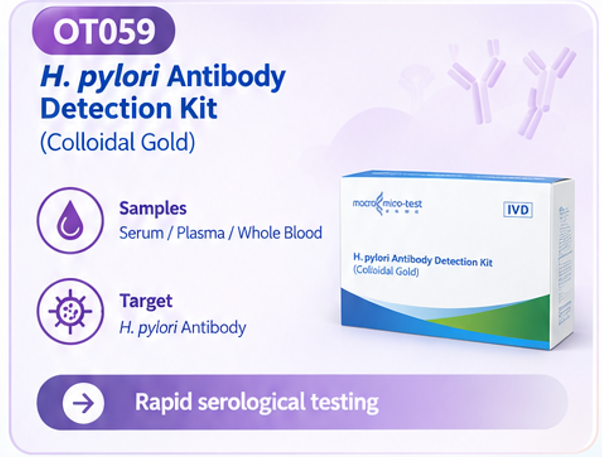
An antibody-based assay for detecting previous or current exposure to H. pylori.
Because antibodies may persist after eradication, its interpretation differs from tests designed to detect active infection.
Together, these four solutions address different testing needs across the H. pylori journey:
Screening → Diagnosis → Characterization → Treatment → Confirmation
The goal is not to use one test for every question, but to choose the right testing technology for the right clinical need.
Macro & Micro-Test
Precise Diagnosis Shapes a Better Life
Post time: Sep-23-2026