
Effective H. pylori management starts with screening, but it doesn’t end there.
Helicobacter pylori (H. pylori) infection is a major risk factor for gastric cancer and is associated with gastritis and peptic ulcer disease. As international attention to gastric cancer prevention continues to grow, population-based H. pylori screening and eradication strategies are becoming increasingly important.
But what does an effective H. pylori management pathway look like? And how can accessible testing methods support different stages of this process?
1. The Matsu Islands Project: Evidence from Population-Based Screening
A landmark example comes from the Matsu Islands, Lienchiang County, Taiwan, China.
Launched in 2004, the Matsu Islands project implemented a large-scale population-based H. pylori screening and eradication programme for residents aged 30 and above.
Long-term findings published in Gut in 2021 demonstrated encouraging results:
85.5% screening coverage among the eligible population.
93.5% treatment referral rate among individuals who tested positive.
A reduction in H. pylori prevalence from 64.2% to 15.0%.
An estimated 53% reduction in gastric cancer incidence compared with the historical control period.
The programme used the ^13C-urea breath test for initial screening, with individuals testing positive referred for eradication treatment.
These findings provide important real-world evidence of how organized screening and eradication strategies can contribute to gastric cancer prevention.
2. International Recommendations: The 2026 NEJM and IARC Report
The importance of population-based H. pylori screening has also received international recognition.
On March 11, 2026, The New England Journal of Medicine published the IARC Working Group Report: Helicobacter pylori Screen-and-Treat Programs for Gastric Cancer Prevention
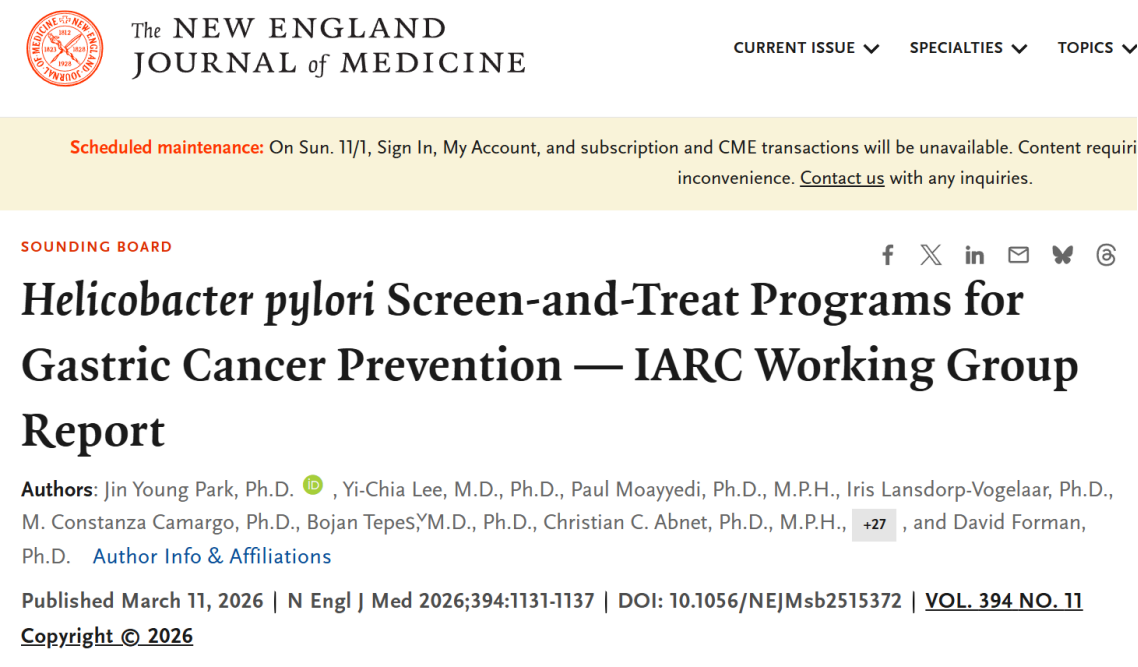
Convened by the International Agency for Research on Cancer (IARC/WHO), the Working Group developed recommendations for implementing population-based H. pylori screen-and-treat programmes.
The report identifies three non-invasive testing approaches for H. pylori detection:
^13C-Urea Breath Test
Stool Antigen Test
Serological Test
It also highlights the role of stool antigen testing and the ^13C-urea breath test in confirming successful eradication, recommending follow-up testing at least four weeks, ideally six weeks, after completion of treatment.
The broader message is clear: successful H. pylori management requires more than identifying infection. It involves appropriate screening, timely treatment, confirmation of eradication and ongoing patient management.
3. From Screening to Follow-up: Where Does Stool Antigen Testing Fit?
An effective H. pylori management pathway involves several interconnected stages.
Initial Screening & Detection
Non-invasive methods such as stool antigen testing and the ^13C-urea breath test can help identify active H. pylori infection.
Stool antigen testing offers a convenient alternative that uses human stool samples without requiring dedicated breath-test analytical instruments.
Auxiliary Diagnosis & Treatment Decisions
Positive screening results should be interpreted in the context of clinical findings and appropriate diagnostic assessment. Confirmed infections should receive eradication treatment based on applicable clinical guidelines and local antimicrobial resistance considerations.
Post-treatment Eradication Confirmation
Identifying infection is only part of the process. Confirming whether eradication has been successful is equally important.
Stool antigen testing is one of the methods recommended by the IARC Working Group for post-treatment confirmation, at the appropriate testing interval.
Long-term Follow-up
For individuals with additional gastric cancer risk factors or existing gastric lesions, further clinical evaluation and follow-up may be necessary even after H. pylori eradication.
Together, these stages form a continuous approach:
Screening → Detection → Treatment → Eradication Confirmation → Follow-up
4. Macro & Micro-Test: A More Hygienic Approach to H. pylori Antigen Detection
To support accessible H. pylori testing, Macro & Micro-Test offers the CE-IVD approved Helicobacter Pylori Antigen Detection Kit (Colloidal Gold), Cat. No. HWTS-OT058.
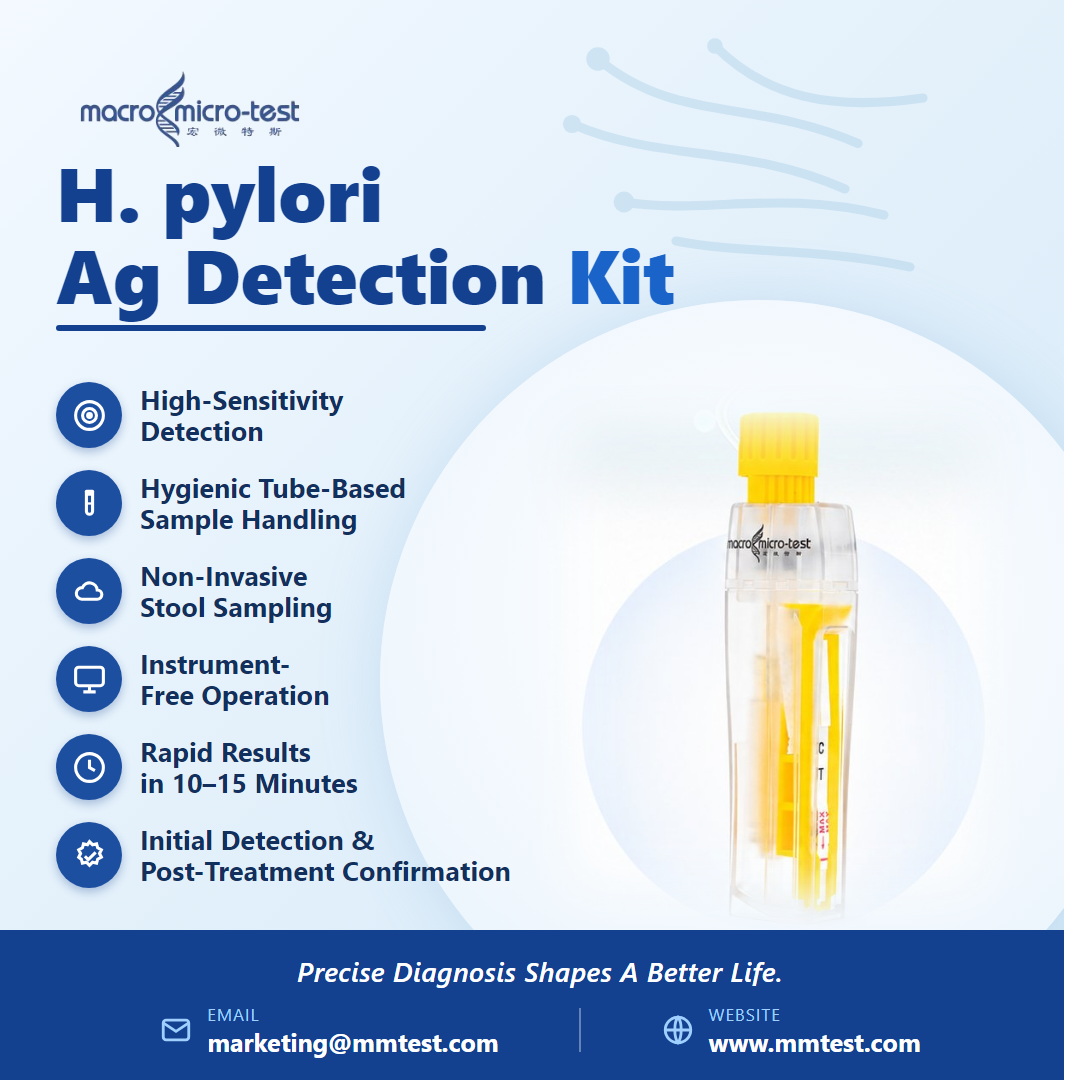
Designed for the qualitative detection of H. pylori antigen in human stool samples, the kit provides a convenient option for the auxiliary diagnosis of H. pylori infection and post-treatment confirmation in clinical gastric disease.
What Makes This Kit Different?
① High-Sensitivity Detection
Designed for sensitive qualitative detection of H. pylori antigens, supporting the identification of active infection.
② Innovative Hygienic Tube-Based Sample Handling
A dedicated tube-based design provides a more hygienic approach to stool sample preparation.
The sample is collected and tested directly in the dedicated sealed tube.
Compared with workflows involving more open sample handling, this design helps reduce direct specimen exposure, accidental spills and potential environmental contamination.
It also supports cleaner work surfaces and better hand hygiene for testing personnel.
Hygienic Tube-Based Design. Cleaner Sample Handling. Greater Convenience.
③ Non-invasive Stool Sampling
Uses human stool samples, avoiding invasive sample collection.
④ Instrument-Free Operation
No auxiliary testing instruments or additional consumables are required.
⑤ Rapid Results
Results can be read within 10–15 minutes, supporting efficient testing workflows.
⑥ Convenient Storage
Storage temperature: 4–30°C.
By combining convenient operation with an improved sample-handling design, the kit offers a practical option for laboratories and healthcare settings seeking accessible stool antigen testing.
6. Planning an H. pylori Screening or Testing Project?
Whether you are developing a population-based screening initiative, establishing a clinical testing programme, or evaluating stool antigen detection methods, selecting a suitable testing solution is an important step.
Macro & Micro-Test welcomes enquiries from clinical laboratories, healthcare institutions, distributors and project partners.
References
- Chiang TH, et al. Mass eradication of Helicobacter pylori to reduce gastric cancer incidence and mortality: a long-term cohort study on Matsu Islands. Gut. 2021;70(2):243–250. DOI: 10.1136/gutjnl-2020-322200.
- Park JY, Lee Y-C, Moayyedi P, et al. Helicobacter pylori Screen-and-Treat Programs for Gastric Cancer Prevention – IARC Working Group Report. N Engl J Med. 2026;394(11):1131–1137. DOI: 10.1056/NEJMsb2515372.
Post time: Oct-30-2026