
The introduction of tyrosine kinase inhibitors (TKIs) has transformed chronic myeloid leukemia (CML) from a life-threatening disease into a long-term manageable condition. Today, effective CML management goes beyond controlling disease progression—it increasingly focuses on achieving and maintaining a deep and durable molecular response.
This is where BCR-ABL1 quantitative monitoring plays a critical role.
BCR-ABL1: A Molecular Indicator of Treatment Response
CML is characterized by the BCR-ABL1 fusion gene, generated by a reciprocal translocation between chromosomes 9 and 22. The resulting fusion protein has constitutively active tyrosine kinase activity, driving abnormal proliferation of myeloid cells.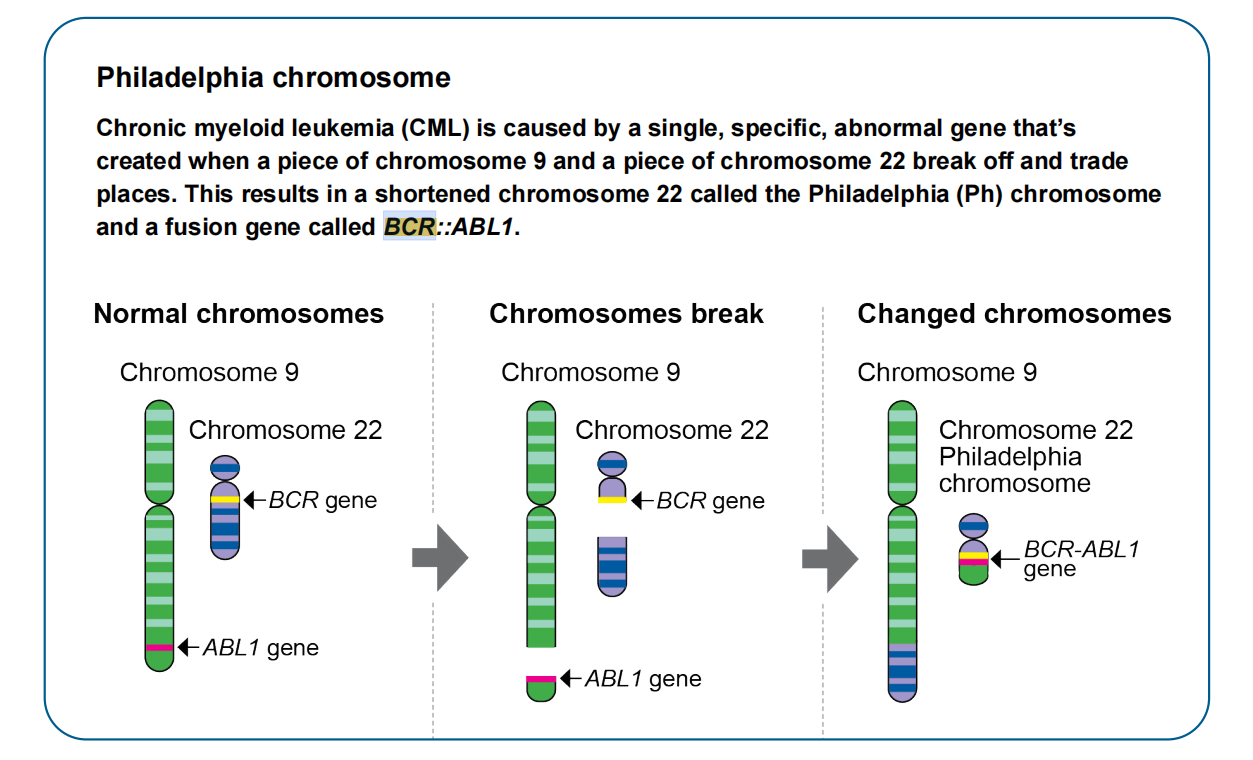
After TKI treatment begins, however, the key question is no longer simply whether BCR-ABL1 is present, but how its level changes over time.
Serial quantitative monitoring of BCR-ABL1 helps clinicians:
- Establish a molecular baseline
- Assess early response to TKI therapy
- Monitor achievement and maintenance of major molecular response
- Evaluate deeper molecular responses
- Identify inadequate response or loss of molecular response
The International Scale (IS) provides a standardized framework for interpreting BCR-ABL1 results:
|
Molecular Response |
BCR-ABL1 %IS |
|
MMR / MR3 |
≤0.1% |
|
MR4 |
≤0.01% |
|
MR4.5 |
≤0.0032% |
|
MR5 |
≤0.001% |
As molecular response becomes deeper, sensitive and standardized BCR-ABL1 monitoring becomes increasingly important.
What Does Modern CML Monitoring Require?
International recommendations from the European Leukemia Net (ELN) and NCCN emphasize regular molecular monitoring throughout TKI therapy. The 2025 ELN recommendations further highlight the importance of sensitive testing, standardized reporting, appropriate transcript identification, and longitudinal monitoring.

1. High sensitivity for deep molecular response
Molecular assays need sufficient analytical sensitivity to detect very low levels of BCR-ABL1 transcripts and support reliable assessment of deep molecular response.
The 2025 ELN recommendations emphasize that molecular testing should be optimized to enable routine detection of MR4.5 in clinical samples.
2. Standardized %IS reporting
BCR-ABL1 results should be appropriately standardized to the International Scale (IS), allowing clinicians to interpret molecular response against internationally recognized milestones such as MMR, MR4, and MR4.5.
Standardized reporting also facilitates longitudinal comparison of results throughout treatment.
3. Regular longitudinal monitoring
Molecular response is dynamic and cannot be fully assessed through a single measurement.
BCR-ABL1 should generally be monitored at least every 3 months until MMR is achieved and confirmed. Once a stable MMR or deeper response has been established, monitoring intervals may be extended according to the clinical situation.
Regular monitoring helps identify inadequate response, loss of response, potential treatment resistance, and sustained deep molecular response.
4. Appropriate transcript identification
The most common CML transcripts are e13a2 and e14a2, encoding p210 BCR-ABL1. Less common transcripts, including e1a2 (p190) and e19a2 (p230), may also occur.
Identifying the patient’s transcript type is therefore important for establishing an appropriate molecular monitoring strategy.
Macro & Micro-Test BCR-ABL1 Quantitative Assay
The Macro & Micro-Test Human BCR-ABL1 Fusion Gene Quantitative Detection Kit (Fluorescence PCR) is designed to support sensitive and quantitative BCR-ABL1 monitoring throughout the CML treatment journey.

The solution combines broad transcript coverage, IS-standardized quantitative reporting, high-sensitivity molecular monitoring, reliable analytical performance, and flexible platform compatibility.
Comprehensive Transcript Coverage
The assay covers three clinically relevant BCR-ABL1 transcript types:
- M-type (p210): e13a2 (b2a2) and e14a2 (b3a2)
- m-type (p190): e1a2
- μ-type (p230): e19a2
This broad coverage supports detection of both common and less common BCR-ABL1 transcript patterns, helping laboratories establish an appropriate molecular monitoring strategy across different patient profiles.
IS-Standardized Quantitative Reporting
The assay supports quantitative BCR-ABL1 %IS reporting, enabling results to be interpreted within the internationally recognized molecular response framework.
With %IS results, clinicians can follow BCR-ABL1 levels over time and assess key molecular response milestones such as MMR and deeper molecular responses.
High-Sensitivity Molecular Monitoring
The assay is designed for sensitive detection of very low levels of BCR-ABL1 transcripts, supporting reliable monitoring of deep molecular responses.
This high-sensitivity capability enables longitudinal assessment of patients with low BCR-ABL1 transcript levels and provides valuable molecular information throughout TKI therapy.
Reliable Analytical Performance
The assay demonstrates strong analytical performance across the covered transcript types, with reported performance including:
- m-type and μ-type sensitivity: 100%
- M-type sensitivity: 97.59%
- M-type specificity: 98.43%
- Internal control to help monitor amplification validity
- UNG-based contamination control to help reduce carryover-related false-positive risk
Together, these features support reliable and consistent molecular testing.
Flexible Sample and Platform Compatibility
The assay is compatible with peripheral blood and bone marrow samples, The assay is compatible with peripheral blood and bone marrow samples, enabling consistent molecular assessment throughout the CML treatment journey.
It has also been evaluated on mainstream real-time fluorescence PCR systems and the Eudemon™ AIO800 automated molecular detection system, allowing laboratories to integrate BCR-ABL1 testing into established molecular workflows or fully automated testing needs.
From Molecular Response to Long-Term Disease Control
The clinical value of BCR-ABL1 quantification lies not in a single laboratory result, but in the trajectory of molecular response over time.
From baseline assessment and early treatment response to MMR and deeper molecular responses, serial BCR-ABL1 measurements provide objective molecular information to support clinical decision-making.
For appropriately selected patients, sustained deep molecular response is also an important component in evaluating TKI discontinuation and the possibility of treatment-free remission.
As CML management continues to evolve, the goal is no longer simply to detect BCR-ABL1. It is to measure molecular response accurately, monitor it consistently, and use molecular data to support long-term disease control.
The Macro & Micro-Test Human BCR-ABL1 Fusion Gene Quantitative Detection Kit brings together comprehensive transcript coverage, IS-standardized quantification, high-sensitivity molecular monitoring, reliable analytical performance, flexible sample compatibility, and broad platform compatibility to support this goal.
From molecular response to long-term disease control, precise BCR-ABL1 monitoring helps turn molecular data into actionable insight.
Precise Diagnosis Shapes a Better Life.
Post time: Aug-20-2026