
A Global Goal That Requires Greater Screening Access
Cervical cancer is one of the most preventable cancers, yet it continues to pose a significant global public health challenge.
According to the World Health Organization (WHO), approximately 604,000 new cases and 280,000 deaths from cervical cancer were reported globally in 2024. Persistent infection with high-risk human papillomavirus (HPV) is responsible for nearly all cervical cancer cases. With effective HPV vaccination, high-performance screening and timely treatment, the vast majority of cervical cancers can be prevented.
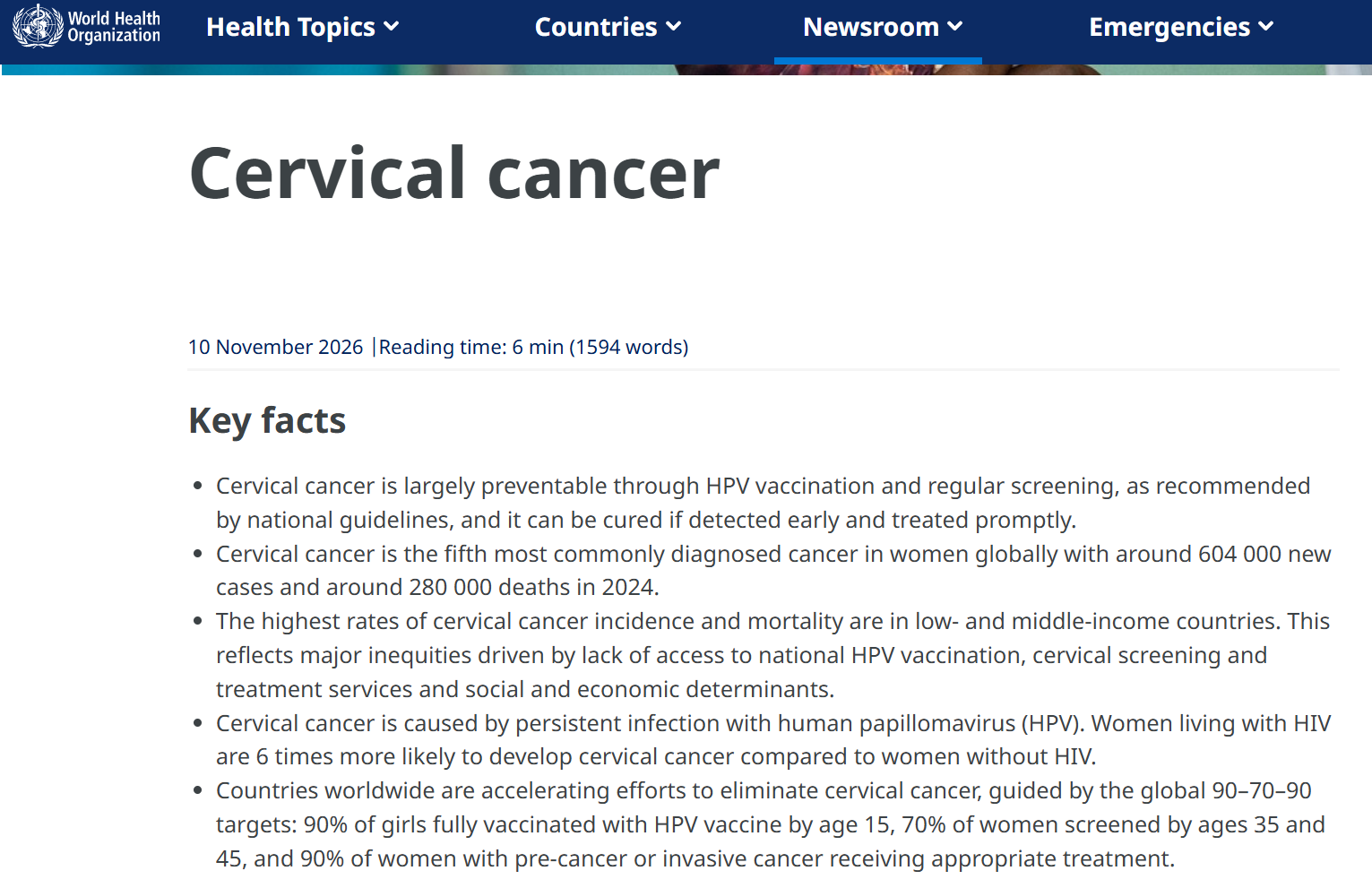
Recognizing this opportunity, WHO launched its Global Strategy to Accelerate the Elimination of Cervical Cancer as a Public Health Problem, establishing an ambitious but achievable 90–70–90 target for 2030:
- 90% of girls fully vaccinated against HPV by the age of 15.
- 70% of women screened with a high-performance test by the ages of 35 and 45.
- 90% of women identified with cervical precancer or invasive cancer receiving appropriate treatment and care.
The ultimate goal is to reduce cervical cancer incidence to fewer than 4 cases per 100,000 women annually, the threshold for elimination as a public health problem.
However, setting a global target is only the beginning. Ensuring that women everywhere can access effective screening remains a major challenge.
The Screening Gap: Why Faster Progress Is Needed
Despite growing awareness and expanded prevention programmes, global screening coverage remains far below the level needed to achieve elimination.
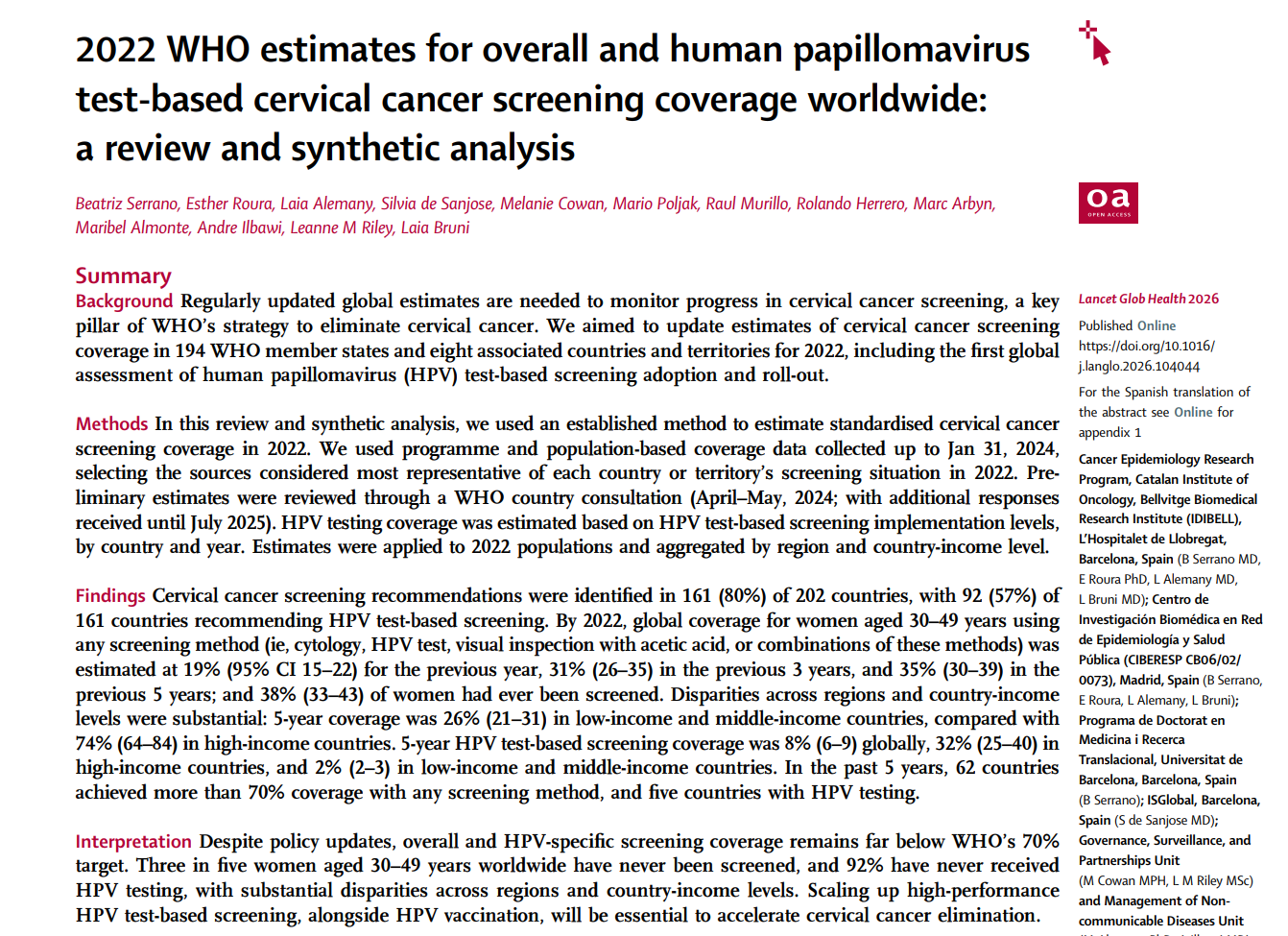
A global analysis published in The Lancet Global Health in 2026, covering 202 countries and territories, highlighted substantial inequalities in cervical cancer screening:
- Only 38% of women aged 30–49 had ever undergone cervical cancer screening.
- Only 35% had been screened within the previous five years using any screening method.
- Five-year HPV test-based screening coverage was just 8% globally.
- The disparity was particularly pronounced between income groups: five-year screening coverage using any method was 74% in high-income countries, compared with 26% in low- and middle-income countries. For HPV testing specifically, the figures were 32% and only 2%, respectively.
These estimates are based on 2022 screening data and demonstrate the considerable gap between current implementation and the ambitions of the WHO strategy.
Several interconnected barriers contribute to this situation:
1. Unequal access to screening services
In many resource-limited settings, access to qualified laboratories, screening facilities and trained healthcare professionals remains restricted. Distance, cost and limited healthcare infrastructure can discourage women from participating in regular screening.
2. Limited screening capacity
Centralized laboratory testing can create logistical challenges, particularly where sample transportation, processing capacity and reporting times are constrained. Expanding screening requires testing solutions that can support different levels of healthcare infrastructure.
3. Barriers to sample collection and participation
Traditional cervical sampling requires a clinical visit and trained personnel. Expanding appropriate specimen options, including urine and vaginal samples where validated and permitted by the assay, can provide additional opportunities to reach women who might otherwise remain unscreened.
4. The need for broader and more flexible testing strategies
Different screening and follow-up pathways require different levels of HPV genotyping information. Laboratories need flexible molecular testing options that can support high-risk HPV identification, genotype-specific detection and broader molecular analysis.
Closing the screening gap therefore requires more than increasing the number of tests. It calls for accessible technologies, flexible testing pathways and stronger connections between screening, follow-up and treatment.
Moving Faster Towards Elimination: Making HPV Screening More Accessible
To accelerate progress towards the 2030 targets, several priorities deserve attention.
Expand access to high-performance molecular screening
WHO recommends HPV DNA testing as the primary screening method rather than relying on visual inspection or cytology alone. Scaling up quality-assured HPV testing can strengthen screening programmes and support earlier identification of women who need further assessment.
Diversify specimen collection approaches
Appropriate specimen flexibility can help screening programmes adapt to local clinical practices and healthcare resources. Cervical and vaginal swabs, as well as urine specimens for assays validated for these sample types, offer laboratories additional testing options.
Bring testing closer to patients
Not every healthcare setting has access to a centralized molecular laboratory. Compact and automated molecular testing systems can help extend testing capabilities to decentralized settings, including hospitals, primary healthcare facilities and other near-patient testing environments.
Improve laboratory efficiency and testing flexibility
Automated workflows, streamlined sample processing and compatibility with established PCR platforms can help laboratories manage different testing needs while making better use of available infrastructure.
Strengthen the entire screening-to-care pathway
A positive HPV result is not a diagnosis of cervical cancer. Appropriate risk assessment, triage, follow-up and treatment are essential to translate screening results into better health outcomes. Testing technologies should therefore support well-organized clinical pathways rather than operate in isolation.
Macro & Micro-Test: Flexible HPV Molecular Testing Solutions
As screening programmes expand, laboratories need molecular testing solutions that can adapt to different clinical requirements, specimen types and testing environments.
Macro & Micro-Test offers a diverse HPV molecular testing portfolio, covering different genotyping strategies and molecular detection approaches to support a wide range of laboratory testing needs.
1. Multiple Genotyping Strategies for Different Testing Needs
From genotype-specific detection to broader HPV genotyping, the portfolio provides laboratories with multiple options.
Limited Genotyping
- 14 Types of High-Risk HPV (16/18 Typing)
- 14 Types of High-Risk HPV (16/18/52 Typing)
- 17 Types of Human Papillomavirus (16/18/6/11/44 Typing)
- 18 Types of High-Risk HPV (16/18 Typing)
Extended HPV Genotyping
- 28 Types of Human Papillomavirus (16/18/45 Typing)
Full Genotyping
- 14 Types of High-Risk Human Papillomavirus
- Human Papillomavirus (28 Types) Genotyping
HPV mRNA Testing
- 15 Types of High-Risk Human Papillomavirus E6/E7 Gene mRNA Detection Kit
These different approaches allow laboratories to select suitable testing strategies according to their screening protocols, genotyping requirements and clinical applications.
2. Flexible Specimen Options and PCR Platform Compatibility
Expanding HPV screening also means making testing more adaptable to real-world laboratory workflows.
Macro & Micro-Test’s HPV molecular testing portfolio offers:
- Multiple Specimen Types: Urine and swab specimens, including cervical andvaginal swabs, depending on the assay. The E6/E7 mRNA assay is designed for swab specimens.
- Flexible PCR Compatibility: Designed for use with widely adopted PCR platforms, allowing laboratories to integrate HPV testing into their existing molecular testing workflows.
- Different Testing Strategies: From targeted high-risk HPV genotyping to broader genotype detection and E6/E7 mRNA analysis, laboratories can select solutions based on their testing requirements.
This flexibility helps laboratories accommodate different screening populations and clinical workflows without relying on a single testing approach.
3. Bringing Molecular Testing Closer to Patients: AIO800
Accessibility is not determined by test availability alone. Where and how testing can be performed also matters.
To support decentralized molecular testing, Macro & Micro-Test offers the AIO800 Sample-to-Answer molecular POCT system, with selected compatible HPV assays.
Designed as a compact, integrated molecular testing platform, AIO800 combines nucleic acid extraction, amplification, detection and result reporting within an automated workflow.
Its key features include:
- Sample-to-Answer Workflow: Integrates multiple molecular testing steps, simplifying routine operations and reducing manual handling.
- Compact and Mobile Design: Supports flexible deployment in different healthcare environments.
- Contamination Prevention: An 11-layer contamination prevention design helps protect testing workflows.
By bringing molecular testing capabilities closer to patients, AIO800 offers an additional testing option for healthcare facilities that may not have access to centralized molecular laboratories.
Turning Screening Opportunities into Meaningful Progress
Cervical cancer elimination is not achieved through vaccination or testing alone. It requires a coordinated approach that connects prevention, accessible screening, accurate detection, follow-up and timely treatment.
As countries work towards the WHO 90–70–90 targets, expanding access to high-performance HPV testing will be an important part of closing existing screening gaps.
At Macro & Micro-Test, we are committed to supporting this effort through flexible HPV molecular testing solutions, multiple specimen options and integrated Sample-to-Answer technology.
More accessible testing. More opportunities for screening. Stronger support for cervical cancer elimination.
Post time: Nov-20-2026