
November 2026 | Raising Awareness, Promoting Antibiotic Stewardship, Supporting Better Diagnosis
Antibiotic Overuse: An Often-Overlooked Risk Factor for C. difficile Infection
Antibiotics are essential for treating bacterial infections. However, their unnecessary use, inappropriate selection, and prolonged administration can have unintended consequences beyond the infection being treated.
One important concern is Clostridioides difficile (C. difficile), a major cause of healthcare-associated infectious diarrhea and antibiotic-associated diarrhea.
Antibiotics can disrupt the natural balance of the gut microbiome by eliminating beneficial bacteria that normally help protect against harmful microorganisms. When this protective balance is disturbed, C. difficile can multiply and produce toxins, potentially leading to C. difficile infection (CDI).
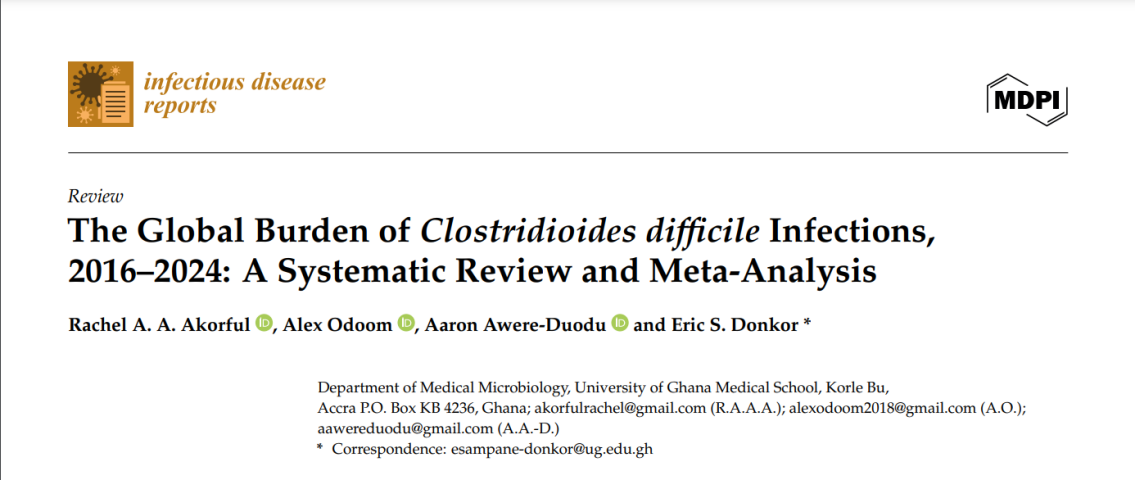
A 2025 systematic review and meta-analysis, covering 59 studies from 24 countries across North America, Europe, the Asia-Pacific region, Latin America, and the Middle East, estimated a pooled incidence of hospital-onset CDI of 5.31 cases per 1,000 hospital admissions and 5.00 cases per 10,000 patient-days.
Antibiotic exposure remains a major concern. Antibiotic therapy is recognized as a leading risk factor for CDI because disruption of the gut microbiota weakens the body’s natural resistance to colonization by C. difficile.
The risk is especially concerning among:
-Older adults, particularly those aged 65 and above
-Hospitalized patients and residents of long-term care facilities
-Patients receiving broad-spectrum or multiple antibiotics
-Individuals with weakened immune systems
-Patients with a previous history of CDI
Antibiotic stewardship is therefore an important part of CDI prevention. Reducing unnecessary antibiotic exposure, selecting appropriate antimicrobial agents, and reviewing treatment duration can help minimize the risk of infection.
Understanding C. difficile: Colonization Is Not Infection
An important challenge in CDI diagnosis is distinguishing asymptomatic colonization from active infection.
C. difficile can be present in the intestinal tract without causing clinical disease. These individuals may carry the organism without experiencing symptoms or requiring CDI treatment. Clinical infection develops when toxigenic strains produce toxins A and B, which damage the intestinal mucosa and trigger inflammation.
Common clinical manifestations include:
-Unexplained, persistent diarrhea
-Abdominal pain or tenderness
-Fever
-Nausea and loss of appetite
-Colitis in more severe cases
The preferred population for CDI testing includes patients with new, unexplained diarrhea, typically defined as three or more unformed stools within 24 hours.Testing should be guided by clinical presentation and consideration of other possible causes of diarrhea, including laxative use.
A positive laboratory result alone does not necessarily establish active CDI. This distinction is particularly important in healthcare settings, where asymptomatic carriage can complicate the interpretation of laboratory findings.
Accurate Diagnosis: The Role of NAAT in CDI Testing Strategies
To improve diagnostic accuracy and reduce the risk of overdiagnosis, ESCMID diagnostic guidance recommends multistep laboratory testing strategies that combine organism or toxin-gene detection with direct toxin detection.
Common approaches include:
-NAAT followed by a toxin A/B enzyme immunoassay (EIA).
-GDH screening followed by toxin A/B EIA, with NAAT or toxigenic culture for further evaluation when results are discordant.
-Combined GDH and toxin A/B testing, with additional molecular confirmation when indicated.
Each method provides different diagnostic information:
GDH Testing
Detects glutamate dehydrogenase, an antigen present in C. difficile. It is useful for sensitive organism screening but cannot independently distinguish toxigenic from non-toxigenic strains.
NAAT (Nucleic Acid Amplification Testing)
Detects toxin-associated genes, such as tcdA and tcdB, providing molecular evidence of toxigenic potential. However, NAAT does not directly detect free toxins or establish whether toxin production is occurring in the patient. Positive results may also occur in asymptomatic carriers.
Toxin A/B Immunoassay
Detects free toxins in stool specimens, providing additional evidence of toxin presence. By combining these methods with clinical assessment, laboratories and clinicians can better interpret results and distinguish active infection from asymptomatic colonization.
Supporting Guideline-Informed CDI Testing with Macro & Micro-Test
To support laboratories implementing molecular testing within CDI diagnostic pathways, Macro & Micro-Test offers the:
Nucleic Acid Detection Kit for Clostridium difficile Toxin A/B Gene (Fluorescence PCR)
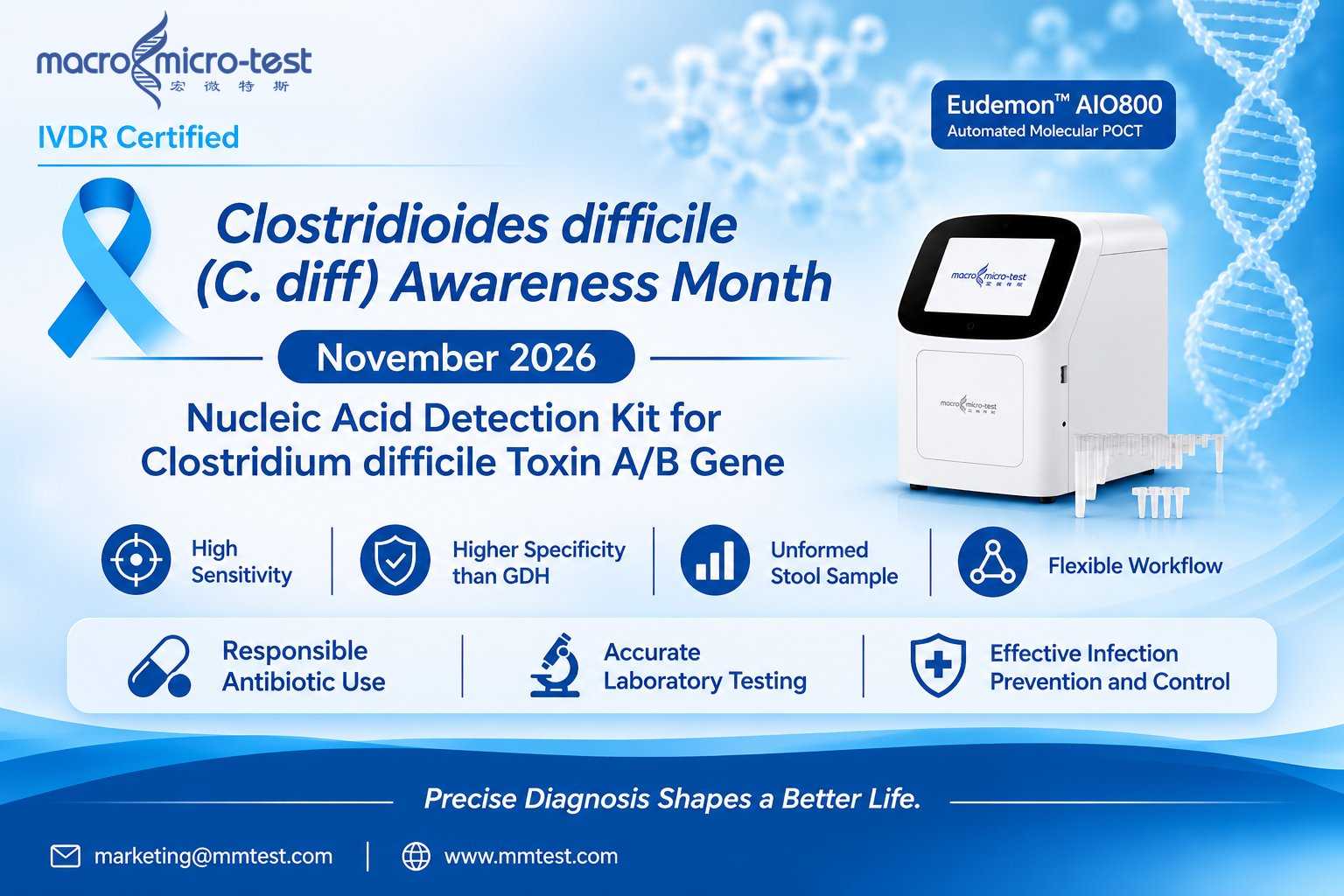
The IVDR-certified assay directly detects the tcdA and tcdB genes from unformed stool specimens, supporting the identification of C. difficile strains carrying toxin-associated genes.
Key Advantages
1. High Sensitivity supporting the detection of low-level toxigenic strains.
2. Specific Toxin-Gene directly targets the genes encoding toxin A (tcdA) and toxin B (tcdB), providing molecular information beyond organism-level GDH screening.
3. Unformed Stool Sample compatible with samples commonly associated with suspected CDI.
4. Flexible Workflow Integration, compatible with mainstream real-time PCR platforms and the fully automated Eudemon™ AIO800 molecular POCT system, supporting different laboratory workflows.
5. IVDR Certified, compliant with the European In Vitro Diagnostic Regulation (IVDR), supporting laboratories seeking reliable molecular testing solutions.
From Awareness to Action: Prevention, Stewardship and Better Diagnosis
Addressing C. difficile requires more than identifying the pathogen. It calls for a comprehensive approach involving responsible antibiotic use, appropriate patient selection, accurate laboratory testing, and effective infection prevention and control.
During C. difficile Awareness Month, it is important to recognize that:
Use antibiotics responsibly: Avoid unnecessary antibiotic prescriptions and promote appropriate antimicrobial selection and duration.
Recognize patients at risk: Pay attention to unexplained diarrhea, especially following recent antibiotic exposure.
Test appropriately: Use suitable stool specimens and guideline-informed diagnostic algorithms.
Interpret results carefully: Consider toxin-gene detection alongside toxin testing and clinical findings.
Strengthen infection prevention: Support appropriate hygiene, environmental cleaning, and healthcare infection-control practices.
Through its IVDR-certified molecular diagnostic solutions, Macro & Micro-Test is committed to supporting laboratories with flexible, sensitive testing options that contribute to more informed CDI diagnostic pathways.
This November, raise awareness of C. difficile. Promote responsible antibiotic use. Support accurate diagnosis.
Macro & Micro-Test | Precise Diagnosis Shapes a Better Life.
Post time: Nov-05-2026